
CTE helps shape future
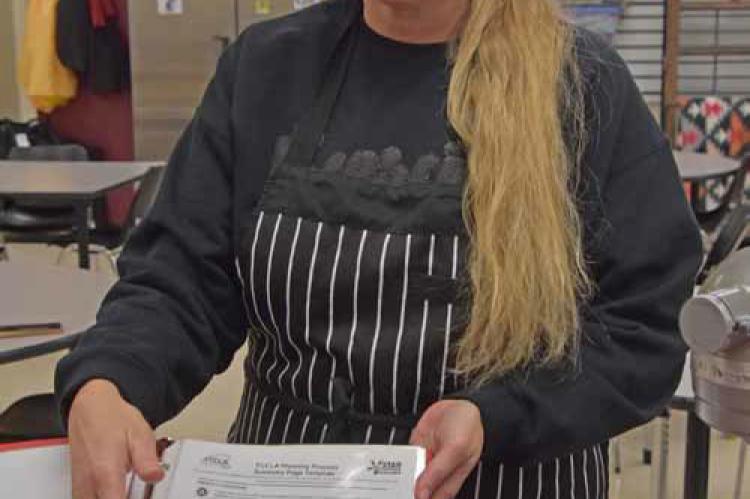
Career and Technical Education classes at Ellsworth Jr./Sr. High School take many forms, from IT to agricultural to shop to culinary and more. For people not familiar with the concept, they may seem like fluff classes, but instead, they are real-life stepping stones to career success.
Mandy Burger, EJSHS Family and Consumer Sciences instructor, explains how FACS is really an expansion on what used to be called “home ec.”
“It is kind of confusing,” she said. “I grew up with home economics. They transitioned home ec into FACS, which stands for Family and Consumer Sciences. Although it is new, it isn’t really new; it’s been here for years. They just renamed it to incorporate more indepth classes to get students ready for the real world.”
Not just focusing on the home kitchen, present-day FACS classes move toward career-based outcomes.
“You’ll see a lot of FACS classrooms going to industry-style kitchens, pushing more toward Culinary 1 and Culinary 2 and baking and pastries and event management, restaurant management to get them ready, so when they leave, if they don’t want to go to a secondary, they have real-world skills to go out and get a real-world, big kid job. That’s kind of the goal, to where that transcends,” Burger said.
Burger, an Ellsworth alumnus, has been teaching at Ellsworth for three years. Her first year she launched an FCCLA chapter, which is a national Career and Technical Student Organization for students in Family and Consumer Sciences.
Each year she’s seen her classes grow. “I think it’s grown; I think it’s gotten bigger and bigger every year. The community support has honestly been amazing from the start,” she said. “The administration support has been amazing from the start. It’s just going to get better.”
Community members can watch the progress on the Facebook page, EJSHS Bearcats FACS Classes.
“When I first came, they were a little unsure about putting things up on Facebook, but I do feel like it is highly important to share what we are doing in the classroom because the community does support us in so many ways, from purchasing our Take and Bakes to coming to our catering meals, or showing up whenever we have bake sales or concession stands,” she said. “We just have so much support from the community, and that money I put back into the classroom. I want them to see what their money is going toward so they know it is not being wasted or used for things it shouldn’t be used for. I feel like that transparency is what Facebook offers us so they can see what the kids are doing with all of that. That’s why I like to post as much as I do.”
Community and administrative support has been essential to the growth of the FACS classes.
“We’ve had to do some work and some growth. Our administration, our CTE coordinator Karl Dawn (Stover), and our superintendent Deena Hilbig have been amazing,” she said. “Some of our support has been from grants. From the community, I’ve gotten a lot of donations. That’s another reason I like to share. Every year before school, I like to post an Amazon wish list of just little things that need to be replaced. That makes student learning easier and every year stuff gets purchased and donated. You’ll see a stack of totes of fabric in the room; I get fabric donated and sewing notions donated.”
One of Burger’s favorite projects is also a beneficiary of donations.
“One of my favorite lessons to teach is canning. I think that is just a lost art that I’d like more kids and parents to know. It’s a way to save money,” she said. “I get so many canning jars donated and canners donated.
There are so many people who just have cases and cases of those in their basement they don’t use. Honestly, since my first year here, I haven’t had to buy but maybe one or two cases of canning jars. It’s been really nice. Some of the stuff is mine from home that we use.”
Grants have also allowed the classes to expand their horizons.
“This last year, we did get a huge grant, and now we have an industrial-sized embroidery machine. We also have a long-arm machine for quilters. It’s an investment,” she said. “Just from donations and grants and personal items, it has slowly grown.”
Burger teaches the core set of FACS classes, which can change as they stack from semester-tosemester.
“My schedule is pretty much locked in with the Kansas FACS standards and I teach everything,” she said. “For example, this semester I have Culinary 1, Baking and Pastry 1 and Baking and Pastry 2. I have seventhgrade FACS exploration, I have career and life planning, I have nutrition, I have FACS essential class, I have family studies, then I have several kids who come in independently and do apparel, which is sewing, so I have some Apparel 3 and 4 students. I have a lot of stacked classes.
Right now, I have nine classes this semester that I am teaching, but they are overlapping. Then I have several more that are semester, like human growth and development will be next year’s first semester, and Culinary 2, which will be offered next year, for my Culinary 1 students.
There’s a lot of stacking so we can offer all of these great classes.”
Burger also teaches classes that allow students to get real-world job certifications before they leave the classroom.
“Since I have started, there is Pro Start. It is a culinary class that you can take as a junior or senior and it will count as college credit if you are going into culinary,” she said. “That’s been added. It kind of stacks in with the culinary classes, so it’s not necessarily anything extra.
They do have to take a test and test out of it, like you would with a college class.
“Kids can walk away from these classes with life skills and go out and get a job and possibly get a job at a higher pay scale than an introductory job if they walk away with certification, like in Pro Start.
“We also offer ServSafe, which is a food safety certification they can take as seniors if they are going into culinary, and it offers a higher pay scale. I know with the ag and the shop areas you can walk away with some certifications.
Those are hugely important for those kids who aren’t made to go to a four-year or two-year school.”
Burger sees the FACS and other CTE classes as being just as important as what are considered core or traditional classes.
“I wouldn’t say there are any traditional or nontraditional classes because of the way our world is going,” she said.
“We are a technologydriven, hands-on world.
It’s not the same as when I was in school, and I think, to be honest, if you asked me, CTE is your traditional classes now, and your core classes are going to be your nontraditional classes.
“You go to some bigger towns and their CTE classes can count for your math or your science and some of your English. You have to think, culinary is science, it’s math, it’s English. If you can’t do fractions, if you don’t know the difference between baking soda and baking powder, it’s the science of baking aspect.
“Those classes are still important — don’t get me wrong — but I think there are not really any traditional or nontraditional classes anymore.
They are all equally important. I really feel like CTE classes, in general, go beyond what your typical classes can offer. I think all of our classes intertwine together to give our students the success they need for the future.”
EJSHS senior Kelli Rodriguez said she’s taken as many FACS classes as possible.
“I just really like them, so I get in to them as much as I can,” she said.
She’s also a member of FCCLA and recently competed at district competition in Teaching Strategies.
“I made a lesson plan and I taught it to the judges,” Rodriguez said.
“I had to come up with it by myself. I’m teaching it to a third grade class and I used teaching strategies and I just explained to them how I did it. I want to be a third grade teacher, and I aide for third grade, so it just helps me more.”
Sophomore Kinley Place also finds the FACS classes and FCCLA valuable.
“I think these classes really help you, not just in school, but your whole life these will benefit you, and Mrs. Burger does a really good job teaching them,” Place said. “I think people kind of think these are more filler classes, but they will help you in so many different aspects of your life, and just not for school and good grades — these are lessons you will take with you for the rest of your life.”
Senior Mallory Dobrinski has taken almost every CTE class offered.
“I’ve taken classes from shop to animal science to apparel — everything actually,” Dobrinski said.
“They definitely help me get through the day. It helps me break up what some people would call your important classes — your core classes — throughout, because I’m a very hands-on learner and I like to do things that help me learn, while in English class I sit in a desk. So being in cooking class or a shop where I actually get to do stuff is a lot more fun to me than sitting in a classroom.
“I feel like the CTE classes are definitely important, especially for those kids that maybe don’t get to cook at home or their family tends to eat out quite a bit. I feel like it’s important to have a class like FACS where they can have the opportunity to learn that, because cooking is a life skill that you need when you move out.
“I definitely feel like they do need to stay funded. They do a lot for the school. I know our FACS program is really blessed to have the ability to do the Bearcat Bites, which are our meals that you take home and cook at home. We get funding from that. When we first came, it was really hard to get the stuff we needed to start the classroom.” Dobrinski said realworld skills are essential in FACS classes.
“Catering is one of my favorite parts of the FACS program that we do, but it takes food safety skills,” she said. “In order to get into the kitchen first, you have to pass a test.”
Burger has added the catering and Bearcat Bites to give FACS students real-world experience.
“I’m very passionate about CTE. That’s a lot of the reasons why we do all the catering and Bearcat Bites, because I know funding is an issue and I want my kids in this classroom and I call them my kids because we’re all like a family,” Burger said. “I want them to be able to cook every day. I want them to be hands-on, every day.”
Editor’s note: This is the second in a series of stories discussing CTE, its role in education and relationship to the community.