
EJSHS helps educate about mental health
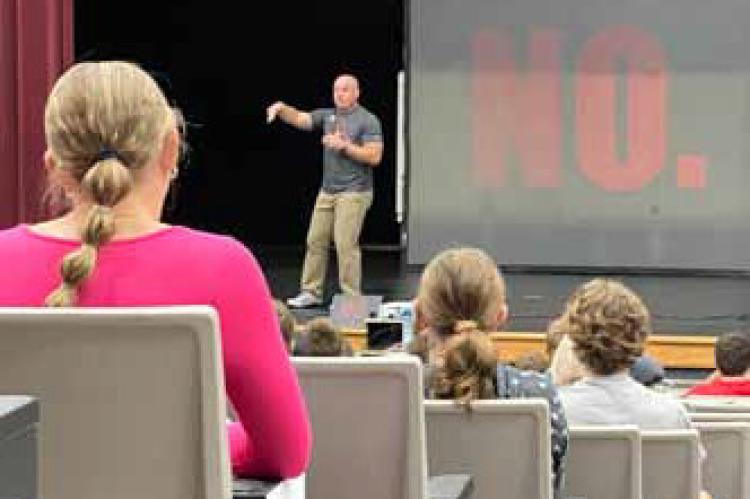
The importance of mental health awareness is an ongoing effort in Ellsworth County, and took center stage at Ellsworth Jr./Sr. High School Oct. 18 during an all-school assembly to hear Damon Parker from The Jones Project.
“I believe that Damon’s personal story of struggle and then finding hope had the most impact on our students,” Mental Health School Counselor Anna Cannon said. “Many of them could relate to his feelings and was grateful that he was willing to share it out loud.”
The Jones Project openly discusses suicide awareness.
“We know that 44 percent of people have mental health struggles and that number is rising,” Cannon said. “For those 44 percent, they learned that they were not alone with their struggles.
“That means that 56 percent of our population needs to have a better understanding of what mental health is and how they can help. Damon brought understanding together for both groups to get on board and help not only themselves, but others.
“He used his theme of “Find A Way” as a universal message to give students a reminder to reach out to each other and to get help, in whatever way that looks like.”
The presentation concluded with each student receiving a sticker with the message “Find A Way” in EJSHS school colors.
“(It was so) that they could put on their cellphones or a close visual place to remind them of this message,” Cannon said.
In 2021, the most recent data available from the Centers for Disease Control, 560 deaths by suicide were reported in Kansas.
The Kansas Health Institute reported in 2022 that suicide was the second leading cause of death in the state for youths age 15-24 from 2016-20. Additionally, Kansas experienced the 10th highest youth suicide rate in the nation during that same time frame.
“It was pretty clear that our student body overwhelmingly said this was one of the best presentations that they have had,” Cannon said. “You could have heard a pin drop in the room when things were important to listen to and rolling laughter when it was truly important to laugh. Students want the stigma around mental health to change.”
Cannon said the COVID-19 pandemic brought mental health to the forefront.
“Both the pandemic and technology has put all people in a relationship deficit for being seen, listened to and heard,” she said. “We are getting together as social humans less and less. If I feel that the pandemic gave us anything, it was room to talk about mental health and how to better understand it. Now we just need to keep breaking down the walls and becoming more one in community.”
Similarly, the Elementary and Secondary School Emergency Relief Fund was part of COVID-19 dollars available to schools. Cannon’s position was created with those funds.
“I think it’s important to note we see mental health as something that is important to have resources available,” Superintendent Deena Hilbig said. “We’ve invested in that using ESSER funds since 2020. Knowing those funds will sunset next year, we need to weigh as a district if the need is there and how to fund it.
“When folks ask why we are increasing the local option budget, we’re taking needs into consideration in how we can best support kids.”
The ESSER money funded a part-time position for Cannon last year. The USD 327 Ellsworth-Kanopolis-Geneseo Board of Education opted to continue to fund her position of mental health school counselor this year.
“This semester I am teaching a wheel class of seventh grade students each nine weeks,” Cannon said. “We are reading through the book “Holes,” which has led to character education conversations about responsibility, reliability, consequences, good deeds, choices, inequity and relationships, just to name a few.”
After reading the book and watching the movie, the class visits the Ellsworth Correctional Facility.
“We plan to take a trip each nine weeks to our local prison to learn about things like hardships of going to prison, what the prison provides to rehabilitate and support inmates,” she said. “(We also discuss) future job opportunities for our students after they are at the right age and stage of life.”
In addition to her time in the classroom, Cannon spends one-on-one time with students.
“I help with mental health and academic needs,” she said. “I believe that our students are very willing to talk about the realities of mental health. Students are very good about watching out for each other and helping speak up for each other when a friend is also in need.
“I feel that our students are breaking down stigmas and generational struggles with those stigmas when it comes to asking for help. I believe this was prominent before COVID-19 began, but it’s more emphasized now as acceptable.”
Investing in mental health resources during junior and senior high years is essential, Cannon said.
“All people have struggles and feelings. The sooner we help them understand their feelings are valid and that there are best practices that students can use in social situations, the better their tools are to be successful,” she said. “If I could teach more people about the brain and how it functions, especially in the middle years of youth, the better they would understand the process of what the body and brain connect in mental health.”
She encourages families to read “The Body Keeps the Score” by Bessel Van Der Kolk M.D.
Adults from 30-50 tend to be a bit more reserved in discussing mental health, but Cannon said it’s imperative to do so.
“(Parents can) model positive attitudes about mental health,” she said. “The better we take care of our own mental health and acknowledge that our mental health is real, the better equipped we are to help someone else with their own mental health.”
Any adult or friend can help keep an eye on tween and teen mental health. Cannon said signs to watch for include a change in academics, sleep patterns or hygiene patterns.
“Socially are they keeping healthy friendships, do you know where your student is going, are you looking at their social media/phones and understanding how their student is navigating their digital world? Are they engaging in activities in and outside of school?” Cannon said. “When a student’s life has imbalance in any of these areas, they might be showing you signs of struggles. Even though we know that students want to grow up and be independent, sometimes they just want someone who loves them to ask if they are OK and if they need help.”
If an adult has a concern about a student, Cannon said they can reach out to the school for support. Support is essential within the school, but is also key outside of the classroom.
“If I could give some thoughts to parents, their student really wants them to be open to listening to them and allowing the students to have their feelings, even if we as parents don’t see it the same way,” Cannon said. “I believe that if parents speak from their heart to their student to let them know that they love them and that they care, telling your student that you’re concerned about them is secondary. They have to feel that you are genuine and truthful in your words and actions.”
Having all of the answers isn’t necessary for adults, she said.
“It’s more important that they are willing to listen and be open to finding answers to helping their students in need,” Cannon said. “I will always have an open door to parents who would ever want to process a conversation with their student if they need guidance. I too may not have the answers, but I will listen and support the parent in the process for their student. It takes many hearts of caring to sometimes find success in the process.”