
The fence stays, council says
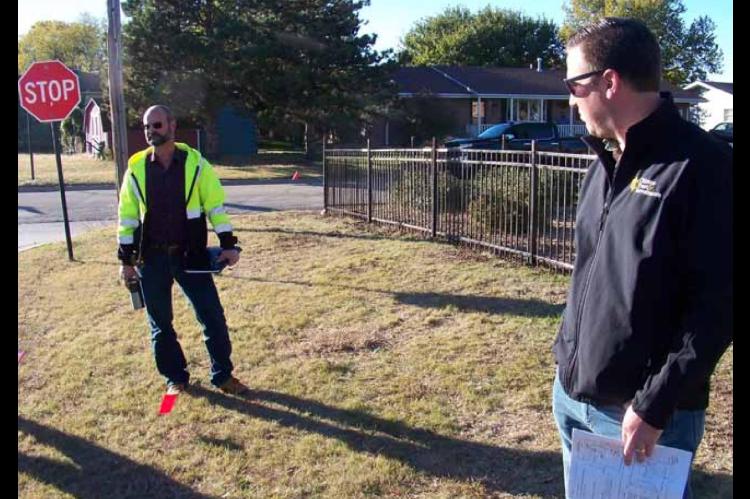
A short, special meeting of the Ellsworth City Council Oct. 29 at the intersection of Kunkle Drive and Aylward Avenue resulted in a residential property owner being allowed to keep his new fence.
According to city administrator Rusty Varnado:
On or around Sept. 15, Rick Connally requested a building permit to reconstruct the fence at his residence at 1201 Aylward.
“He filled out the paperwork and submitted it back to city hall. The street superintendent and building inspector, Mr. (Delvin) Bettenbrock, reviewed it and asked me to come on site to view the project and issue an opinion on the propriety of the project.”
Varnado said he observed the existing fence and thought it wasn’t cosmetically pleasing.
“So I understood why Mr. Connally wanted it replaced.”
Varnado said he and Bettenbrock agreed the setback probably did not meet city code.
“However, it was an existing fence and the standard practice is if you are replacing a structure such as a fence or a sidewalk you can replace a like type back in the same spot.”
Varnado and Connally discussed the construction and composition of the fence.
“He informed me that it would be very similar to the one across from the child care center. I did speak to the vendor and he informed me that it would be a fence with 5/8 inch pickets with a 3 1/2 inch gap.”
Connally offered to remove bushes in the corner of the property, if it were a visual obstruction, or at least to keep the bushes cut down.
“We went to the corner of Alyward and Kunkle looking east and we saw no visual obstruction from there,” Varnado added.
After viewing it from a westward looking direction and finding no visual obstruction there as well, Varnado affirmed Connally’s permit and authorized him to begin construction on his fence.
Ellsworth Police Chief Emil Halfhill also inspected the fence and agreed with Varnado there were no visual obstructions with the placement of the fence.
Council member Darcy Hansen said she drove the area the day before in her Ford Explorer and did not see any obstruction.
Background information provided by the city stated a concern has been voiced that the new fence, which covers the southern and eastern portions of the property, poses a traffic hazard and a request is being made to revoke the permit. In the event the permit is revoked, then the city would force Connally to remove any portion of the new fence that has already been installed. The city may then have to reimburse Connally up to $17,000.
Asked what the setback requirement was in that neighborhood, Patrick Hoffman, city attorney, said he didn’t see exactly what it was.
“The prior fence established the setback in the same place this fence is now,” Hoffman said. “It happens quite a bit in Ellsworth where property that has been in place for a while has a setback that might not be up to the current code of the community, but replacement has been allowed.”
Hoffman said the initial permitting process determined the fence was not a traffic hazard.
“Patrick, the first line of our fence code, what does it say,” asked Scritchfield.
“No fence shall be constructed closer to the street than the front setback line established for the district,” Hoffman said.
“Our code refers to the front house setback, what would you say the intent of that is,” Scritchfield asked Hoffman.
“We regulate front fences,” Hoffman said. “We generally don’t allow front yard fences.”
“And why is that,” Scritchfield asked Hoffman.
“Because of the potential for obstruction and just general neighborhood cleanliness, I think,” Hoffman answered.
Scritchfield then asked about any state statutes regulating obstructions.
He referred to wording in statutes that allow counties to remove obstructions from private property.
“If there is a traffic hazard, the owner of the rural property has to remove it or the local authority can tell them to remove it,” Hoffman said. “To me, I feel like it’s a finding for whoever has authority to determine if it is a traffic hazard. Traffic hazards are somewhat hard to define.”
Scritchfield said the fence is within the city’s right-of-way.
“So the previous fence was also in our right-of-way,” Hoffman said.
Hoffman said to him, it’s all a matter of whether the city allows residents to replace existing structures with in kind structures. However, he noted city code does not define in-kind well enough for him to say.
“So it’s up the council,” Hoffman added.
Varnado said he stands on his past statements regarding the approval of the construction of the new fence.
Scritchfield said the fence is non-conforming and he didn’t think the council could allow it to stay on the city right-of-way.
“We have very clear guidelines about what the right-of-way can be used for,” he said. “And private installations ain’t one of them.”
Hoffman said if the city has to use the right-of-way, it would knock the fence out.
“It just puts the risk to the landowner,” he added.
Connally said he did understand that.