
Green Garden keeps growing
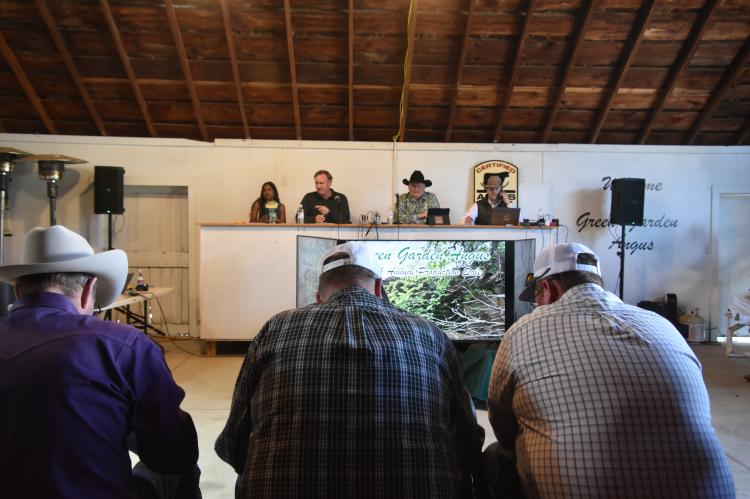
LORRAINE — Green Garden Angus, an Ellsworth County Angus farm, was established in 1932. The progress it has made since then has made it an influence in many farms in the county, as well as the region and country.
The farm held its 67th annual production sale April 6 in Lorraine. It is the longest-running annual registered Angus sale in Kansas. The sale wasn’t just in person — it was available worldwide at www.cci.live.
The operation all began with Lewis Janssen.
“In 1932, Dick’s grandfather, Lewis Janssen, was running 30 head of commercial cow/calf pairs, when he bought two registered Angus heifers from the Parker Parish herd in Raymond, Kan., to incorporate into his cattle operation,” Shelly Janssen said. The late Dick Janssen was her husband. He passed in 2024. “At that time, the farm consisted of a wheat, milo, alfalfa and silage farming program, along with the 30 commercial cows and now, two registered Angus heifers.
“The farm grew in acreage as well as in registered cow numbers, with purchases from many local Angus breeders. Many Angus ranches were popping up in central Kansas and people were naming their ranches after the township they lived in, hence the name Green Garden Angus, which is located in Green Garden Township. Now, 84 years later, we run 350 mother cows along with our farming program.”
The progress was all in the family.
Dick and his father, Herschel, continued to grow the Angus herd after Lewis passed.
“Herschel continued to add registered cows and kept back his own heifers in the herd. After Dick graduated from Kansas State University with a degree in animal science and Arlo returned from the Army, they joined their dad and grandfather, and continued adding numbers of breeding stock,” Shelly said.
The sale itself is like a family reunion with family members all on duty and hosting multiple events to welcome both old and new customers.
The family offered dinner at 6:30 p.m. Sunday. On Monday morning, the day of the sale, they provided coffee and pastries, while the Ellsworth County Cattlewomen hosted a free lunch at 11:30 a.m.
Attendees received a glossy 44-page sale catalog upon arrival, which was also available online. The catalog outlined all of the sale bulls, as well as 10 bulls from Perkins Angus Ranch, which belongs to Dick and Shelly’s daughter, Elizabeth, and her husband, Dustin Perkins.
As time went on, the Janssens made changes to their herd, but they were always committed to the breed.
“Our commitment to the cattle industry has changed little in the 84 years we have been in the Angus industry. Our goal is to provide problem-free seedstock that maximizes profit. All bulls sold are free of all known genetic defects and conditions,” the catalog says.
Growth has taken time, some wins and some losses and the use of new technology.
“We have been using all the available tools (EPD, genetic testing, ultrasound data) to selectively breed our cattle herd in order to create a more predictable product,” Shelly said.
She could think of three major moments that changed the farm’s growth trajectory.
“The first one was in 1983 after a terrible calving season due to a bull we used that did not sire light birth weight calves,” Shelly said. “We decided we needed to focus on producing calving-ease seed stock for our customers as well as for ourselves.”
To facilitate that solution, in 1983 Green Garden began a program of stacking pedigrees to create a calving ease product, using the 18th century concept of breeding “like begets like.”
“We used herd sires that were stacked several generations deep in low birth weight EPDs (expected progeny differences) and bred them to cows with similar genetic makeup that also had production histories of low actual birth weights,” she said. “Calving difficulty has almost been eliminated, with the exception of an occasional abnormal presentation. Having a live calf is the first step. The second step we strive for is keeping expenses to a minimum.”
The second major change for the farm happened in 1986.
“The second was in 1986 when the director of Certified Angus Beef (in its infancy) asked Dick to meet him in Liberal at the National Beef Packing Plant to view steers being graded that had met the visual specifications to qualify for CAB,” she said.
Certified Angus Beef (CAB) is a premium branded beef designation owned by the American Angus Association.
“We decided that it doesn’t cost any more to produce a superior carcass than that of a lesser grade,” she said. “Using the same concept of breeding ‘like to like’ that we used to create our calving ease seed stock, we began stacking pedigrees of known superior carcass seed stock, generated off of actual harvest data, to females in our herd of similar genetic makeup.
The third big change was in 1989.
“In 1989, John Brethour, a meat animal research scientist at the KSU Beef Research Center in Hays, selected our herd to aid in his development of ultrasound technology,” she said. “This led to our third moment, which is when we started DNA testing. First, there were just a few markers done by a group called Gene Star. Now, that technology has reached the 100,000-marker mark. The American Angus Association has a 50K that we use that is Angus-specific for all the herd. We also test all the cattle with Igenity Beef, which is an all breed testing.”
The farm is still very much in the family.
“After Ben (son) and Elizabeth returned to the farm, they both took active roles in the day-to-day work, along with Dick and me,” Shelly said. “As Dick’s health dictated that he slow down, the kids pretty much started running the whole operation, with Dick and I as their advisers.
“Currently, Ben is in charge of Green Garden’s 350 mother cows. Elizabeth and her husband Dustin are running around 100 heads of registered cows in Rice County.
“Ben runs the day-to-day operations with the help of three people: Joel Bunch takes daily care of the bulls from the time they are weaned until they get sold at our production sale or by private treaty, Patrick Zamrzla takes daily care of the cows and calves and Joseph Bunch assists Patrick and fills in for Joel when needed.
“I have always run, and still do, the office, putting in all the data for the registered business, all the accounting, designing the sale catalog and doing all the advertising.
“After Elizabeth came back, she also helped in the office, especially helping me with advertising and building the sale catalog, which was done in-house. Ben was always in charge of the farming operation with wheat, milo, corn, alfalfa and prairie hay production, along with the day-to-day cattle work, which we all helped with.
“In 2020, Elizabeth and Dustin had the opportunity to purchase ground in Rice County and are running a separate cattle operation, starting with the 50 cows she had in the Green Garden herd.”
The sale itself was due to months of work and met with success.
“This was one of the best sales we have ever had. We were very pleased,” Shelly said. “We sold 92 lots to five different states for an average of $7,486,” she said.
With the online and phone sales, some of the bulls were destined to travel with one heading to Yakima, Wash.
But some of the biggest impact of the sale will be locally.
“Of the 92 bulls sold on Monday, 18 percent went to new buyers and 72 perent went to repeat buyers, and most of them within a 100-mile radius,” Shelly said. “Ellsworth County ranchers have been especially good. We have customers who go back to their grandfathers buying some of the first registered Angus bulls we sold 67 years ago. Most of the repeat customers that bought bulls on sale day have been buying bulls from Green Garden for the last 30 years, and we are most thankful for that.”
Green Garden has been instrumental in mentoring area ranchers moving into Angus.
“With all the new technology the last 40 years in the Angus business, we would all try to be there to explain to our customers the benefits of this technology,” she said. “It was not unusual for a customer to be sitting at our kitchen table with Dick, studying that year’s catalog to see which bulls they would need to buy to complement what they had already been using from Green Garden.”
As for future progress, Shelly, Ben and Elizabeth are embracing more ways to make the herd successful, some of which focus on the maternal line.
“There are several new traits, like bovine congestive heart failure, that they can now test for that with a DNA sample, tenderness markers and maternal traits we feel are very important for the breed that we will be focusing on,” she said.