
New information surfaces about 117-year-old Showman murders
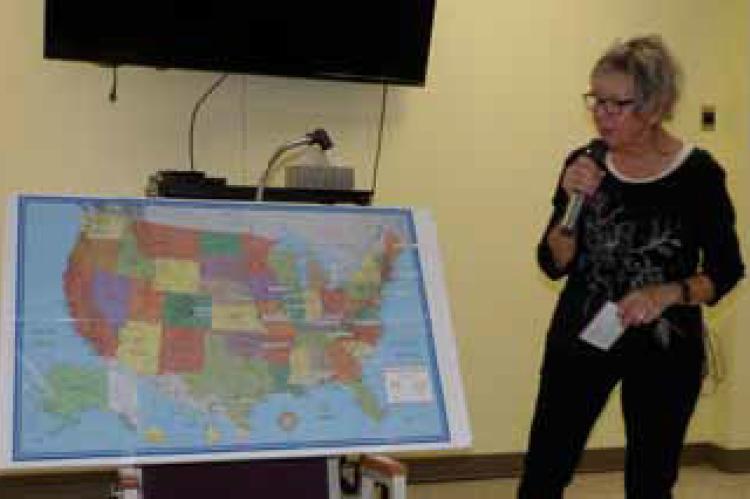
An update pointing to a possible solution to the 117-year-old ax murders of the Showman family on the outskirts of Ellsworth was given Sunday during the annual meeting of the Ellsworth County Historical Society.
“I thought I knew about the Showman murders,” Historical Society Board President Cynthia Edgerle said. “I was incorrect.”
During the nighttime hours of Oct. 15, 1911, five members of the Showman family — William (Will), his wife Pauline (Polly) and their three young children, including a 1-and-a-halfyear- old — were all murdered in their beds with the blunt end of an ax that was used to crush their skulls.
“They didn’t have an enemy in the world,” Edgerle noted.
Their two-room (kitchen/ dining room and one bedroom) house was located at 9th Street and Park Street in west Ellsworth. Since the murders, the location came to be known locally by a grisly monicker, “Hatchet House.”
According to Edgerle, the murder wasn’t discovered until 5 p.m. the next afternoon by a neighbor, Mrs. Snook. The Showmans and the toddler were in one bed and the two children were in another.
When police arrived on scene, the five bodies were found with coverings, either a blanket, pillowcase or something similiar, over their heads to stop the splatter of blood. There was no sign of struggle.
Only one body, Polly’s, had been moved. She was pulled to the end of the bed and “subjected to treatment that clearly indicated the fiend was possessed of an abnormal hatred towards her,” according to reports from the local newspaper, the Ellsworth Reporter.
Edgerle said the newspapers of the day were really delicate on the topic, so exactly what happened to Mrs. Showman remains a mystery, other than she was “posed.”
The hatchet was found in the house. It had been wiped clean with a rag. The blinds in the house had been pulled and the front door had probably been jammed shut. Police also found that whoever entered the home entered through the window after removing the window screen.
Technology-wise, Edgerle noted the Ellsworth of 1911 was much different than the Ellsworth of 2026. The telephone and the automobile were in their infancy. People read by coal lights or kerosene lamps. She said homes then were heated with wood, so everyone had a woodpile outside their house, along with an ax to cut the wood.
Edgerle noted Ellsworth was on the intersection of two railroads, the Kansas Pacific and the Frisco.
At the time, law enforcement in Ellsworth consisted of a police chief, Marshal Merrit, and a helper. The Ellsworth County Sheriff was R.W. Bradshaw. He lived two houses down from the Showman family.
“They tended to be concerned only with local activities,” Edgerle said. “Worldwide news was not an issue.”
Law enforcement in Ellsworth relied on private investigators for more help when needed. The private investigators earned reward money that families offered for various crimes.
“So private investigators could make a bigger statement of local gossip than they needed to because they were trying to earn the money from this crime,” Edgerle said. “So if there was gossip about a particular person of a particular family, they dug into it, whether that person was guilty or not.”
In addition, in 1911 Ellsworth, there was no such thing as DNA collection or crime scene containment and fingerprinting was in its infancy.
“Fingerprinting was done in prisons,” Edgerle said. “People who had been in prison were fingerprinted, but there was no central repository to find out the fingerprint from Colorado to the fingerprint from Kansas to the fingerprint in Illinois, so there really wasn’t a good connection to the crime. It was human nature, very much, maybe now, as then. It was typical to name a suspect before they even knew who it might be.”
When bloodhounds requested from the sheriff in Abilene got to the Showman home, they smelled the bloody rag, went outside, circled the house, then ran straight to the junction of the two railroads and stopped cold.
Merrit, who heard a noise in the back of his house the night of the murders but found nothing, also later found one of his window screens had been removed.
According to Edgerle, that piece of information started the local gossip train in Ellsworth rolling.
That gossip, in combination with the fact that local townspeople had an elevated fear for their safety, proved volatile.
One man, a drunken stranger who coincidentally arrived in Ellsworth the night of the murder and checked into the local hotel, was arrested and later released. A manhunt was also conducted for another innocent man, who was later found in British Columbia. He was arrested, tried, then acquitted of the crime. Another innocent man, who had been in a local ax throwing contest and just happened to own an ax with a chip in it, similar to the one used in the murders, was also accused but not arrested.
“As you can see, rumor or speculation, whatever, affected Ellsworth for many months,” Edgerle said.
She noted parents at the time were warned not to send their children out for Halloween because people were so nervous they might shoot them by mistake.
In the Oct. 19 Ellsworth Reporter, a story noted the Showman family murders were almost identical to the slaying of six people in Colorado Springs, Colo., on Sept. 21, 1911, and the killing of a man, his wife and daughter in Monmouth, Ill., on Oct. 1, 1911.
The Reporter also noted that in each case, an ax was the instrument of death and the victims were killed while they slept.
“That’s what we knew then,” Edgerle said.
Edgerle then presented — as Paul Harvey was fond of saying — “the rest of the story.”
In 2006, Beth Klingensmith, a student from Colorado Springs studying sociology at Emporia State University, was writing her master’s thesis. The subject of that thesis was the murders and the consequences of all of the people who were accused of the murders in Colorado Springs, Ellsworth, Illinois and Iowa. During her research, the student also discovered two more similar murders — one in Oregon and one in Washington State.
“She (Klingensmith) supposed at that time that this was a serial killer,” Edgerle said. “Serial killer was not a common term — especially not in 1911, but even in 2006.”
In 2017, Bill James and his daughter, Rachel McCarthy James, wrote a book titled “The Man From The Train: The Solving of a Century-Old Serial Killer Mystery.”
After three years of research for their book, James and his daughter found lots of commonalities in these family murders. They found in almost every case the murders took place at a location near a railroad junction where the murderer could hop on and off a passing train. They found that in almost every case, someone local was accused and many people were put on trial.
Of these, four people were sent to prison, four people were legally executed and seven people were lynched.
It was also discovered that six months after the Showmans were murdered, a similar family murder occurred in Paola.
It was also discovered that the murderer went from state-to-state, traveling from Virginia to West Virginia to Kentucky and so on.
The Jameses assumed the murderer worked in a logging or mining area and was proficient with an ax.
“We had a salt mine right along the Frisco,” Edgerle said. “A salt mine in Kanopolis.”
During research for the book, the James’s discovered similar murders occurred in 1898 in Massachusetts (the first such murder), then periodically from 1909 through 1912.
The Jameses also found there was usually a lamp left lit at the scene of the murders and sometimes the bodies were stacked upon each other. Very early in his killing spree, the murderer tried to burn his victims’ houses down. Nothing was ever stolen during the murders.
“There were so many common denominators that the James family kept looking,” Edgerle said.
The Jameses’ research on the 1898 murder was particularly interesting.
“The theory is that this is the only group that can give us much description about who this man was,” Edgerle said.
It turns out that after the neighbors in Massachusetts discovered the Nelson family murders, Paul Mueller, a German immigrant, worked for Mr. Nelson, who was a farmer.
Mueller was a short, not particularly handsome man, who had no social skills, who had a very bad temper and who was seen buying train tickets on the night which the neighbors suspected the murders took place.
While the neighbors provided a description of Mueller, nobody thought at the time to draw up a wanted poster with Mueller on it and distribute it.
“So there was no evidence of what he (Mueller) really looked like,” Edgerle said.
Edgerle said in all, the James family predicts Mueller murdered at least 153 people, but will guarantee 116 people because of the stories they could find in newspapers. Add to that the four people who were legally executed on his behalf, as well as the seven people who were lynched.
“There were so many people that were affected by Paul Mueller,” Edgerle noted.
Mueller’s last family murder in the United States was in Illinois.
“Then he disappeared,” Edgerle said.
Nonetheless, the James family keep looking for additional family murders. They found that in 1922, there was a murder in Germany called “Hinterkaifeck,” which is German for “Murder at Kaifeck.”
“It is considered the most notorious, unsolved crime in Germany,” Edgerle said. “They made a horror movie about it.”
It remains unknown where Mueller died.
Edgerle ended her update with a simple question.
“So, did he (Mueller) make it to Germany or not?” she asked. “The Jameses want you to decide.”
Editor’s note: The Ellsworth County Historical Society is currently ordering copies of “The Man From the Train” for sale at a cost of $30 each. Proceeds will go to ECHS. To order a copy or for more information, call Edgerle at 785-4723059.