
Bezemek passes on stories so the horror isn’t forgotten
More than 70 years ago, Jim Bezemek, a farm boy from Ellsworth County, witnessed the definition of man’s inhumanity to man as he and his fellow soldiers from the United States Army’s 79th Division helped liberate the Nazi’s infamous Buchenwald concentration camp in Germany in the Spring of 1945.
For Bezemek, who is now in his 90s and a resident of the Good Samaritan Home in Ellsworth, said the smells of Buchenwald haunt him to this day.
“It was one of the worst smells I’ve had in my life,” he said in a recent interview with the Independent-Reporter. “It’s not a human smell.”
Bezemek remembers giving six or seven women being held at Buchenwald some candy bars he carried in his pocket. The women were lying on the ground — too weak to get up on their own — so Bezemek and other soldiers helped them up.
“I never really smelled anything in my life that stunk so bad,” he said.
Bezemek and his unit were at Buchenwald from about 6 a.m. until noon.
He said horrific sights such as those his unit saw at Buchenwald should be advertised for all the world to see. He also remembers another Kansan, Gen. Dwight D. Eisenhower, who also saw the horrors of the Holocaust firsthand, talking about what he had witnessed.
Bezemek was one of millions of brave young Americans who fought and defeated Adolf Hitler’s dream of a Thousand Year Reich in what Eisenhower called “The Great Crusade” — the liberation of Europe during World War II.
Bezemek, a graduate of Lorraine High School, entered the Army at age 19 on Aug. 18, 1943, and went through basic training at a camp in Oklahoma. After basic, he was trained in field artillery at Fort Sill, Okla. He was assigned to the 42nd Infantry Division — the famous Rainbow Division.
After completing field artillery training, he was reassigned to the 79th Infantry Division — The Cross of Lorraine.
In early 1944, Bezemek and the 79th Division left Fort Miles Standish in Massachusetts on a troop ship bound for Warrington, England. At around 6 p.m. on June 8, 1944, he and his unit waded ashore on Utah Beach on the Normandy coast of France just two days after the D-Day landings took place.
“Utah Beach wasn’t bad,” Bezemek, a Technician Fifth Grade (T-5), said.“I’m glad we missed Omaha (Beach).”
Omaha Beach, along with Utah Beach, were the two beaches assigned to the U.S. Army on D-Day. Omaha Beach become known as “Bloody Omaha” for the high number of casualties inflicted that day on the Americans by the German Army, who were defending the Normandy coast from the allied invasion.
Bezemek’s unit lost just one soldier in action on Utah Beach.
“He got wounded pretty bad,” Bezemek said.“They sent him back to England.”
Bezemek said there was just spotty gunfire taken by the Americans as they made their way across the flat Utah Beach and into the French countryside.
“We chased them out,” he noted, adding “Everybody stayed awake all night long.”
As Bezemek and his unit advanced into France, they came across a German civilian with a tale Bezemek will never forget.
“There was a guy who peeked around a tree or limb or something, I can’t remember, and said is there anybody from Kansas,” Bezemek said.“I said, yeah, I am.”
The man, a German civilian, said he lived in Oakley or Colby — Bezemek couldn’t remember which.
“So we sat there and talked,” Bezemek said.“And he was our enemy.”
The man told Bezemek he had traveled to Germany for a vacation, and that the Germans took all of his money so he was unable to get back to the U.S.
“I had to tell you that story because he was so nice,” Bezemek said.
The exchange between Bezemek and the German civilian took place in Lorraine, France — something ironic for a young man from Lorraine, Kan. serving in the Cross of Lorraine Division.
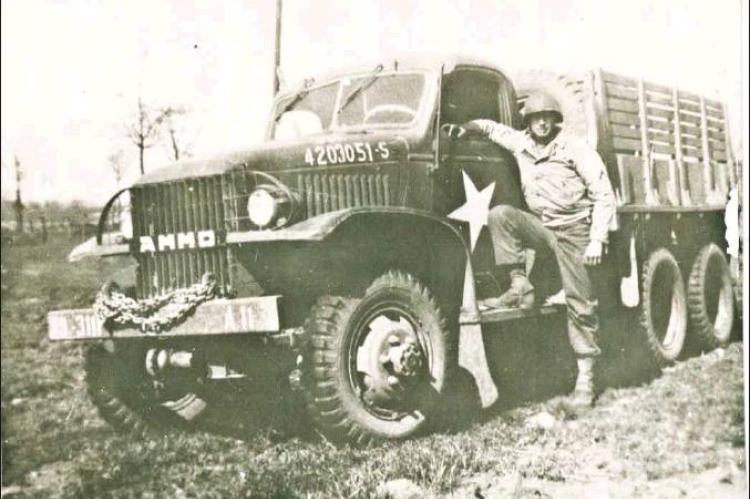
Bezemek also remembers a fellow soldier from Tonganoxie, Kan. who painted a star on the door of his ammunition truck.
“He was an artist,” Bezemek said.“That guy could draw anything.”
According to Army regulations, the star on the door was to point up. Unfortunately, the star the artist painted on the truck door was sideways.
“The commanding officer, when he saw the star, said that was not regulation because the star needed to point straight up,” Kelly Clark, Bezemek’s nephew, said.“And Jim said I had to stop too fast and when I hit the break, the star slid over.”
After France, Bezemek and the 79th Division fought its way through Belgium, Luxembourg and into Germany.
During winter fighting in the Black Forest Mountains between December, 1944, and January, 1945, Bezemek’s fingers and toes froze.
“I went on sick call and they told me there was nothing they could do about it, so that was that,” he said.
Being an ammo truck driver, Bezemek delivered ammunition to the front lines, then returned to allied territory to restock. He said he was unaware it was a dangerous job until after the war.
Because he was constantly on the move, Bezemek said he had no idea that the war had ended
“But the German population knew it,” he said.“They came running up to our artillery battery and said the war is over.”
Bezemek said the end of the war left him with both good and bad feelings.
“We made it,” he said. “The Germans weren’t bad people. But we had a job to do.”