
Changing of the ECF Guard
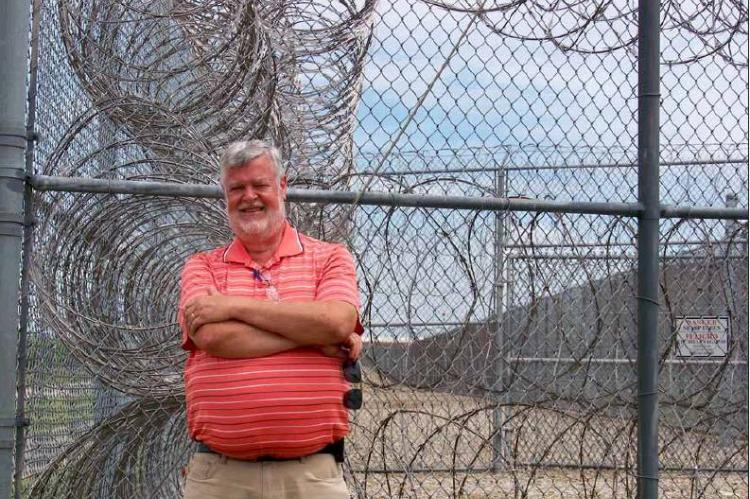
When Todd Britton started working for the Kansas Department of Corrections, Ellsworth Correctional Facility was just being constructed.
It was 1988, and the chances of finding gainful employment in Ellsworth were slim.
At the time, the community just lost a major employer — a plant that once made wiring harnesses for the automobile industry. Almost overnight, the business and its 750 jobs were shipped to Mexico — never to return.
Other local businesses were also closing shop, leaving few options for employment. Some chose to commute, while others made the painful decision to move away.
Britton, who’d grown up in Ellsworth, drove back and forth to work every day until a 60-day corporate restructuring notice from his employer changed everything. And just like that, he was exactly like the hundreds of others now scrambling, looking for some way, any way, to make ends meet.
Britton quickly picked up a job at a local funeral home. While grateful, he knew there were few opportunities for advancement there. He kept the job for a while, but then decided to apply with the KDOC. That was more than three decades ago.
He retired in June.
Looking back, Britton said he never really considered a career in corrections. The job just seemed to find him.
“I was the 12th individual they hired, and I knew they had benefits,” he said. “Options were limited in the area, and I didn’t want to relocate.”
For Britton, the new prison couldn’t have come at a better time.
Britton’s father, Roy, and his brother, Dane, now both deceased, hatched the idea for a prison and spearheaded the effort to bring it to their community. The Brittons, businessmen who each served individual terms as president of Citizens State Bank & Trust Co., knew attracting a major employer was the difference between their small town surviving or fading away.
So they talked to the right people, and didn’t take no for an answer. Eventually, in 1987, state corrections officials, Kansas lawmakers and other bureaucrats chose Ellsworth as the location for the state’s newest prison. The facility would house 256 medium-custody inmates. A year later, the Legislature granted a request to expand the facility to house 516 offenders of various custody levels.
“My father thought of it from an economic development standpoint, and my brother spoke to the community,” Britton said. “The city hired a lobbyist to get it built here, and they came up with an attractive package.”
“This came at a time when, if you didn’t have a parent with a business, there were no opportunities. The community was dying, and the prison added some stability to the community.”
Today, the prison houses around 915 inmates, according to a recent KDOC population report.
The first 20 inmates arrived at the prison in April 1988 to help with prison construction. At the time, offenders stayed in the former National Guard armory before moving into ECF in July. Early on, new employees like Britton worked out of a rental space downtown. The makeshift office shared space with what is now part of Central Kansas Dentistry. In those early days, Britton worked as a procurement officer, ordering, accepting and keeping track of building materials during construction.
He moved on to other jobs such as administrative officer and a unit team manager. For 15 years, Britton handled the day-today management of 70-80 offenders assigned to his housing unit. As manager, he helped inmates by providing progress reviews, counseling and other services. Eventually in 2007, he returned to an administrative role, overseeing public relations and policy.
“Every day is different, and I think that’s why I’ve stayed so long,” he said.
Through the years, Britton witnessed countless changes. Some of the biggest resulted from advancements in technology.
“When we opened, we didn’t have computers,” he said.“Today, there’s so much technology. But before technology, reports were multiples copies of copies. Everything was paper. Today, there’s probably 300 cameras here. There was maybe only a dozen or so when I started.”
Along with the addition of computers and video surveillance are touchscreen control systems used in housing units and other areas of the facility.
He’s also seen shifts in offender programs and services. Today, ECF has a variety of programs ranging from education and skilled labor training to work programs.
The facility also offers programs focused on giving back to the community such as bicycle and wheelchair refurbishing and puppy obedience and socialization training. Other programs offered are aimed at giving offenders the tools to successfully re-enter society and complete parole.
“Programs come, and programs go,” Britton said.“At one time, there were virtually no programs here, because there was no funding. Now, they’re talking about prison reform, and I don’t know that that’s always the best answer.”
He’s also seen a dramatic shift in the prison population, which also affects services state corrections officials are providing.
“We’re seeing these offenders coming in as younger and more violent,” Britton said. “But we also have a lot of guys 60 to 65 years old with medical issues. There are population changes, and guys staying in longer. We have guys under 20 years old. We have six individuals serving life. We have 125 guys who have at least 20 years to go in their sentences. When some of these men came to prison, technology like cell phones didn’t exist. Some of these guys don’t know how to use a cell phone. We’re going to have to teach them how to use things like that. Society has changed, and those are the challenges we face.”
Britton admits the corrections field has changed dramatically in 30 years, and in most cases, he said, it’s been for the better. However, the job of a Kansas corrections officer still remains a tough one.
“Salaries are not competitive, and it’s hard to survive,” he said. “You can’t survive on that. It’s like our (secretary of corrections said), when we hire an employee, they also have a wife and a family who qualify for food stamps ... that to me is a shame. I’m sure lawmakers look at it differently. I understand we have to spend money on education, and spend money on mental health and that’s good.
“I’ve actually had people ask, ‘Can’t you just feed them anything more than bread and water?’ Yes. These people have made horrible choices, but the majority will be released ... they will return to their hometowns and their families because that’s their support structure. You can’t put your head in the sand, and you have to adequately fund these programs. You can’t lock these people up and throw away the key. If you don’t change behaviors, they will continue.
“I have a very thankless job. I never know if I was successful in reaching someone. My successes are unknowns. The failures are the only ones you see because they’re the ones who come back. It’s a very hard business. If you’re the victim of a crime, you look at it differently. If you’re a family member of an offender, you look at it a different way, too, but, our moral structure has to change to change these behaviors.”
In retirement, Britton said he and his wife, Karen, who is retired from Citizens State Bank, plan to travel. One trip he hopes to plan soon is an autumn visit to the East Coast.
“But there’s a lot of places we’d like to go,” he said.
Eventually, he said, they’ll have to consider whether they’ll move closer to their adult children. But for now, they’re staying in Ellsworth.
“This came at a time when, if you didn’t have a parent with a business, there were no opportunities.”
Todd Britton
Retired from the Ellsworth Correctional Facility