
From the files of the Holyrood Gazette
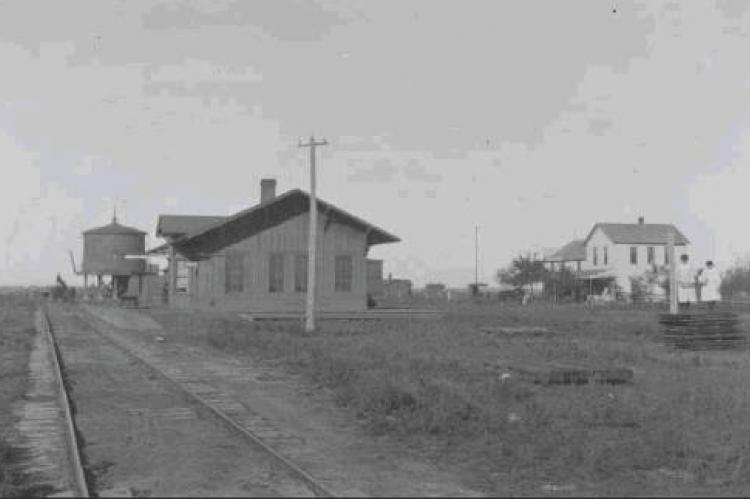
From the files of the Feb. 26, 1936 edition of the Holyrood Gazette, courtesy of Don Siemsen, Holyrood.
MARCUS SIEMSEN RETROSPECTS PART
OF HIS LIFE’S
BIOGRAPHY
From time of youth on Isle of Fehmarn, Germany,
to manhood near
Holyrood
Marcus Siemsen, one of the community’s early day settlers who will observe his 71st birthday anniversary on June 12th, is one Holyrood citizen, who, it would seem, was born in a locality made famous and stressed by the great authors of English literature and verse.
Tho remote from the site of the immortal Lady of the Lake, the “Isle of Fehmarn,” is suggestive of mythical writings and prose.
It was on the Island of Fehmarn, in the East Sea, Germany, that Mr. Siemsen made his appearance as a child, the son of Mr. and Mrs. Fred Siemsen, on the 12th day of June 1865.
Fourteen years of his youth were spent on this isle which inhabited a population of 10,000 souls at that time. Whether it has grown, Mr. Siemsen is unable to tell. The countryside of Fehmarn is depicting of rare beauty. Multitudes of wheats, peas, and clovers were sown and reaped bumper crops. Dairying was then, and perhaps is now, a major vocation with the farmers.
As he neared his 15th birthday anniversary Mr. Siemsen heard much of the then “new land” and he had an uncle living in the United States. So with friends he booked passage on the steamship Westphalia for this country which proved to be a turning point in his life, the future holding in store for him a life of many experiences and hardships in conquering backwatds elements of a new and vastly different country.
He departed the port of Hamburg on the boat Westphalia on his maiden voyage across the “big pond.” A comparatively tame trip was offset the last three days by dense fogs. The voyage was completed in two weeks as the ship docked at harbor in New York City.
Mr. Siemsen soon departed on a train for Chicago with some of his friends. After three days in the “windy city” he set out for Ellsworth, Kansas. The conductor failed to awaken him at Ellsworth and the next stop was at Wilson where he got off.
There was no welcome awaiting Mr. Siemsen here and the environment was peculiarly different than what he anticipated. A hotel near the station caught his eye. The clear night was perturbed as two men were quarreling and fighting in front of the place. Somewhat taken aback Mr. Siemsen finally gained courage to inquire if he could put up for the night, that he was to get off at Ellsworth, but was unable to do so thru no fault of his. No train was bound back east for some hours. The innkeeper replied that all the rooms were taken and there was no place for him to sleep. The other man who was in the argument, accommodated the stranger and said that if he wished he could retire in his room, on the floor. Mr. Siemsen said that he spent a very restless night, his first in this novel country.
The man who was so generous and kind hearted had a blacksmith shop near the hotel, and it is believed, is living to this day. He is of Bohemian nationality.
Eventually Mr. Siemsen returned to Ellsworth and remained at the Continental Hotel before renewing acquaintances with his uncle, Henry Johansen, with whom he returned to the farm, northwest of present Holyrood, on land which is now tilled by Fred Johnansen. At Ellsworth he was told that day — the 20th of May of 1880 — that it was their first rain that year.
His first year in Kansas Mr. Siemsen assisted his uncle. The second year of farm labor was for Henry Miller, his land is presently owned by Louis Meyer. A third year of similar work for his uncle again, but his fourth and fifth years of farm duties and chores were for Fred Orth, which farm is now the present land of C. J. Strarmann, in the oil field of that name northeast of Holyrood.
The wage scale was meager in the early ‘80’s. He was hired by the year and paid wages by the year. For the five years of farm work he was paid, respectively, $30, $60, $70, $125 and $180.
Three years after his arrival in this country his father and brother, Henry, arrived. A year after this his mother and two sisters came from Germany.
In the year 1884 Mr. Siemsen’s father purchased from the Union Pacific railroad company the one-quarter section of land which the former still retains a short distance north of Holyrood. The railway owned twenty miles of land on each side of their tracks in those days. One section of land was open for homesteading and the other section was property of the U.P. The deceased Siemsen paid $9.55 per acre for the land. In February of 1885 Mr. Siemsen secured a team and plow from Orth and broke sod.
Ernestine Frehse became his bride in 1882 on the 15th day of May. For several years Mr. and Mrs. Siemsen lived on a farm 4 miles northwest of Holyrood. Later he bought a farm of Joe Young northwest of Holyrood in Barton county where they lived for four years. On this place hardships and privations were plentiful in the winter of 1898 and 1899. Especially was this winter noteworthy in retrospective history because of the cold and snow. The windmill, furnishing the water supply for many head of cattle, broke. It took a week for repairs to arrive in Holyrood, During this time Mr. Siemsen was compelled to draw water from a well with buckets for thirsty cattle. Mrs. Siemsen stood vigil near the well with clubs to ward off the thirsty animals who crowded close as they anticipated the fresh drinking water. It was a hazardous task. Hard work also. The repairs arrived as the seven days of waiting was completed. The livery man from Holyrood loaded them on his cart as he started to leave town for Mr. Siemsen’s place, the parts fell and broke as the liveryman drove hurriedly over the railroad tracks. More grief. Mr. Siemsen had to wait another week for extra repairs again. The pioneers had no easy time of it.
Mrs. Siemsen died on December 22nd, 1930. Three years ago Mr. Siemsen and his daughters Anna and Martha and son Max moved to Holyrood city. Martha now being affiliated as an employe[e] with a home for feeble minded individuals at Marthasville, Missouri. Henry and Albert are farmers in this vicinity and Fred is a farmer of the Frederick community. Two other daughters, Mrs. Paul Weltge, is the wife of a pastor at Hutchinson, Minnesota, and Mrs. A. T. Lueck resides in this city.
Mr. Siemsen has retired from active work but voluntarily is aligned with several Holyrood business firms. He and his son Max and daughter Anna residing in the home in east Holyrood which property Mr. Siemsen bought three years ago from Fred Durr.
Some entertaining incidents are recalled by Mr. Siemsen in his earlier days. The fall and winter of 1882 and 1883 was eventful because of a maximum amount of water due to unexpected rains classified as either late or early in the season. Plum Creek, which runs thru his land, was full of water for a long time. The alfalfa ground northwest of Holyrood was under water and water forced across the road several feet deep. The escapade of Joe Zajic, liveryman in early 1900, and Dr. G. F. Zerzan, present physician, in which their lives were endangered as they were submerged in the creek as they attempted to answer an urgent sick call to the Ed Matoush farm farther north. That was in 1909, and at the season of year when rains again descended in frequent rapidity.
In 1889 Holly Ridley, a farmer north of Holyrood, recorded a bumper wheat yield of 50 bushels average to the acre. The fall of 1888 was unusually dry. Indications for even a fair wheat crop in 1889 were bad. But on the 15th of January, 1889, a thunderstorm precipitated heavy rainfalls. A steady snow followed up and covered the rain which covered the ground six inches to a foot in depth. This freakish weather being instrumental beyond a doubt for a surprising yield several months later.
In 1888 and 1889 when Mr. Siemsen lived in Barton county northwest of Holyrood, his farm was a stopping place on the mail route between Holyrood and Wilson. Holyrood then being a fair sized trading place as it had been founded on the present site since 1886. Oft times he [the mail carrier] would bring eggs to Holyrood for Mr. Siemsen when returning from Wilson and when enroute would return the case in which the eggs were dispensed and also the meager exchange of merchandise or whatever was forthcoming which was very little. And the reason is explained readily as Mr. Siemsen exclaimed,“Eggs sold for 4 cents a dozen.” Never did he pay more than 75 cents for a large sack of flour in the early days. Farmers didn’t get much for their products but neither was the cost of living expensive.
Mr. Siemsen is a very pleasing man in conservation and it is utterly impossible to cover all the data he related. It is far more entertaining to have him talk in person, and for some very enjoyable and pleasant evenings around the fire, one must call on the elder gentleman or invite him to one’s house. His congeniality will undoubtably cause him to consent to such entertaining reminiscing. Remarkable is the fact that Mr. Siemsen’s memory relative to certain questions, dates, etc., is not a bit hazy and especially dates of bygone events in days of yore which he answered without a moment’s hesitation.
The historic items on this page appear as they did in the original publication.