
Insurance building moves ahead
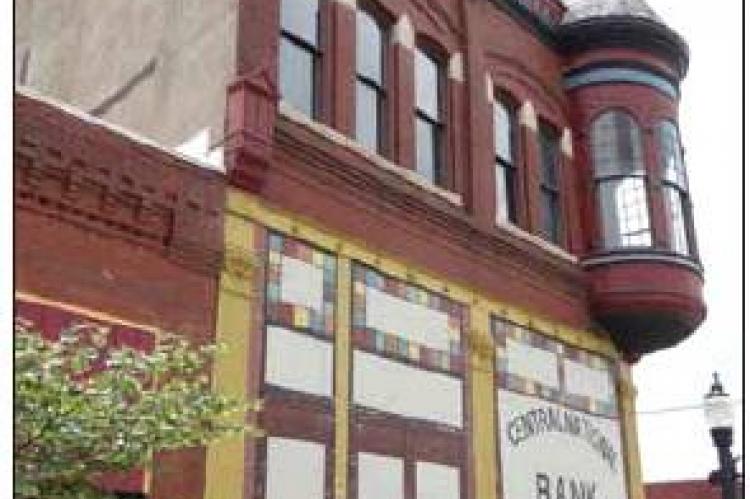
An effort to build the National Drovers Hall of Fame received a big push last month after receiving nearly $70,000 in state funding to preserve a piece of Ellsworth history.
And while plans for the hall of fame have changed slightly, the focus hasn’t as board members move forward developing a tourist attraction that recounts the drover story in a way that’s never been told before.
The award was the second time in the group’s 20-year history a significant state grant was received to save Ellsworth’s most widely recognized building — the two-story, Victorian brick Insurance Building.
The grant, totaling $69,840, was awarded by the Heritage Trust Fund, a state program providing matching funds to preserve properties listed in the National Register of Historic Places or the Register of Historic Kansas Places. The HTF reimburses project-related expenses for projects preserving or restoring historic properties.
The Drovers also received a major gift from cattleman and philanthropist Jack Vanier, owner of the CK Ranch near Brookville, on the Ellsworth-Saline county line.
Tami McGreevy, president of the Drovers Board of Directors, said the grant pushes the project forward into the next phase.
“The Heritage Trust Fund Grant is a larger sum of money that will help in phase two of restoring the Insurance Building, as we call it,” McGreevy said. “That is the main, two-story building that the National Drovers spent over $700,000 on when bringing the outside back to what we now see in downtown Ellsworth. We realize this project has been ongoing, but it is important to remember that it takes very large sums of money to refurbish a building such as this.”
The Hall of Fame was the idea of local cowboy and historian Jim Gray. Gray’s vision would introduce the drover to a national audience. While there are other museums featuring the drover story, the Insurance Building would house an international museum and research center, telling the story on a much larger scale.
Early on, dollars and sweat helped shore up the Insurance Building now preserved on the National Register of Historic Places. A grant received several years ago, which awarded tax credits to donors, helped stabilize the roof and restore the building’s signature oriel. But by the time the building was stabilized, funds were depleted.
Initially, Gray envisioned the museum featuring a library and research center, boasting an extensive collection of books, periodicals and documents focusing on the drover. The exhibits found in the Insurance Building would help narrate the drover story, beginning with his earliest days. Some of those proposed exhibits include the evolvement of the cattle drives in Mexico to English settlements in Texas and Louisiana, and eventually, the blending of the English cow pens and Mexican corral cultures, the pre-Civil War era and other periods, including the late-1860s through the 1870s.
Other proposed plans for the upper level of the Insurance Building included a library, offices and an observation room for researchers.
Some of the other original plans also included a structure to the north of the Insurance Building referred to as the middle building, and a new building behind it which would house a proposed theatre. However, plans have changed with the recent sale of the building where the proposed theatre would have been located. But the focus hasn’t, McGreevy said.
“…We still look toward being the National Drovers Hall of Fame,” she said. “Drovers far and wide, as well as local, and their memorabilia, deserve the recognition we hope to develop over time. We still have a fabulous three-story insurance building to restore and house fabulous displays and more.”
“Once fully restored, this community will see an amazing, historic tourist attraction that will contribute to the historic preservation of the district in which it is located while honoring the drover and their contribution to our past, and entertaining visitors (who) darken its doors.”
McGreevy said officials will soon unveil a new website dedicated to keeping the public updated on the board’s progress.
“It will be worth the visit over and over until you can visit the attraction for real, and, then after, just to keep up with all of the great things that we know our future holds,” she said. McGreevy said the HTF grant was written to start work on the building’s dilapidated interior.
“Specifically, funded work items include rehabilitation of the basement including floors, foundation masonry, stairs and storefront,” she said.
Currently, the board is working with an architect to develop a master plan for the structure. Once developed, board members will seek bids.
McGreevy said board members are excited to be working with two interns from Kansas State University’s Chapman Center for Rural Studies, who are guiding them through the nationally recognized Standards and Excellence Program for History Organizations. The accredited program helps small- and midsized historical organizations assess and gauge themselves against national museum standards.
“By completing this program through the American Association for State and Local History, we will earn certificates that communicate our achievements to the community and stakeholders,” she said.
Because the project is supported through donations, the Drovers will be raising money by hosting a beer garden at Cowtown Days. McGreevy said the garden will be open in Cowtown Plaza on Friday night during the kickoff concert and again on Saturday.
“Once we get the ball rolling on the construction, we will work toward more fundraising efforts,” McGreevy said.
Though the project has received some grant funding, even more funding opportunities exist out there for nonprofits. But board members must be discerning when it comes to endowments, she said.
“When looking toward other grants, this is always something that we are thinking about, and that our interns will be helping us with throughout the summer,” McGreevy said.“We will have to be selective in our choices with regards to matching funds, or cash available, as right now our funds available are designated to what is needed to comply with the Heritage Trust Fund Grant. There is a percentage of the current grant that we must have available throughout the process in order to remain compliant, as this grant can be reimbursed.”
Once those grant funds are drained, she said the board plans to explore other financing options, such as grants, additional fundraisers, member recruitment and donation requests on a larger scale.
While McGreevy admits the process isn’t a speedy one, she is certain the project will make headway this year.
“We hope to see visual progress before the end of 2019,” she said.