
Lights, camera, action
Fort Harker, the documentary, will screen Oct. 20
KANOPOLIS — What started as a 15- to 20-minute video has ended as an almost 57-minute documentary on the history of Fort Harker.
“Fort Harker. Gateway Post to the Frontier” is set for its first public screening at 3 p.m. Sunday, Oct. 20, at the Performing Arts Center at Ellsworth Junior/Senior High School.
The showing will be followed by a question and answer session with producer Steve Stultz of Hays and assistant producer and writer Greg Heller of Ellsworth. Both men are in the documentary as narrators and Heller appears on screen. The opening scene has Heller walking through the grass at the fort’s original site along the Smoky Hill River and talking about the western expansion after the Civil War. He is attired in the period uniform he wears as curator of the Fort Harker Guardhouse Museum at Kanopolis.
Fort Ellsworth was renamed Fort Harker in 1866. Construction on the new fort in what would later become the town of Kanopolis started in 1867.
In an interview this past week with the I-R, Heller said the full story of Fort Harker would take three to five hours to tell in a movie. As a result, he focused on “the birth of Fort Harker, its tragedies, its triumphs, how it was directly involved in the Indian wars and how important it was in the development of the frontier.”
Seeds for the project were planted in early 2017 as directors of the Ellsworth County Historical Society made plans to keep the guardhouse museum open while Heller went into the hospital for a kidney transplant. Directors decided to commission a video of Heller giving his tour talk so volunteers would have something to show to visitors.
However, one thing led to another and a 20-minute video grew into a fullblown documentary with Stultz as the producer and videographer. Stultz, who studied documentary production in college, also is involved in a paranormal activity company, which has combed the guardhouse with its equipment.
Using a $3,000 grant from the Smoky Hills Charitable Foundation, Heller and Stultz started on their Fort Harker project following Heller’s recovery from surgery.
“The more I wrote the script, the more detailed it got, the bigger it got ... it became like a Hollywood production,” Heller said.
And, like with many Hollywood productions, there were glitches.
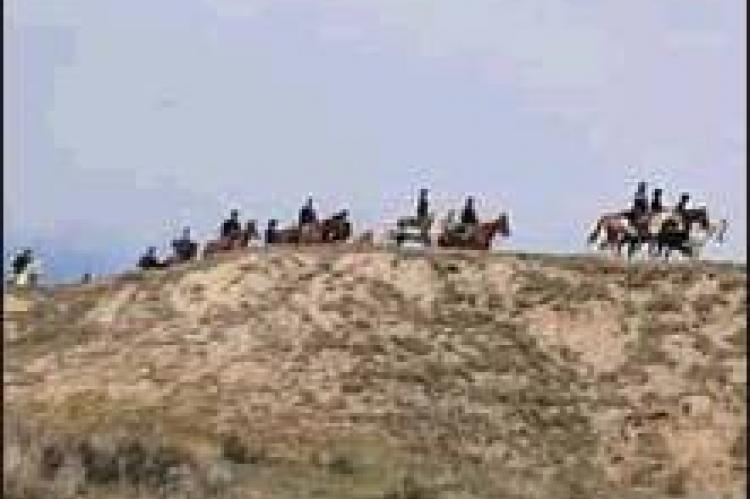
One of the most potentially serious was the day filming of the calvary and Native American scenes were to be filmed at Fort Wallace and Stultz fell ill. Fort Wallace, which stands on the plains of western Kansas, was involved because the landscape around Fort Harker had changed so dramatically in the past century.
“There were too many trees,” Heller said.
Officials at Fort Wallace came to the rescue again. Videographer Brenda Troch of Farmgirl Film Productions lived a mile from the scene where Heller planned to film. Troch, who was involved in a similar product at Fort Wallace, donated her time and skills to the Fort Harker project for “such a great public purpose.” Re-enactors and the other actors also worked for free.
“We had a lot of in-kind contributions,” Heller said.
The day of filming ended when a storm, which eventually produced a tornado, moved toward the movie crew. The tornado never touched down, but Heller said his truck took a beating from hail.
At Kanopolis, Heller recruited friends and relatives to fill the five chapters of Fort Harker history contained in the documentary. His wife, Cee, portrayed a nurse. She was dressed in an apron and other period attire made by her sister.
Kyle Derousseau, an Ellsworth plumber, played a trooper. Thad Donley was a young trooper who died during the cholera epidemic of the summer of 1867. Eight hundred fell ill at Fort Harker, including 60 who died.
“You’d get up in the morning and feel good and be dead by noon,” Heller said.
Ian Trevethan of Russell was Dr. Sternberg, who was stationed at Fort Harker and discovered the cause of the cholera outbreak — a spring-fed pond contaminated by runoff from a nearby horse corral.
Trevethan’s daughter, Hannah, is Ann Baldwin in the documentary. Baldwin arrived as a bride at old Fort Harker and lived in a dugout.
The DVDs are available for sale at the guardhouse museum, the Hodgden House Museum complex at Ellsworth or at postrockstudiosofk.wixsite.com/postrock/ onlinestore-1. Cost is $28 with tax.
Heller said Kansas has six forts and Fort Harker and Fort Wallace are the only two not to receive state or federal funds. All proceeds from the documentary will go to support operations at Fort Harker.
[Fort Wallace also has a DVD, “Thof ’s Dragon,” which is available for sale.]
Heller said a public screening of “Fort Harker” also is planned at Wallace; however, a date has not been set.