
Mysteries of the Sandstone
Ellsworth County featured in new book about local petroglyphs left many years by area’s early residents
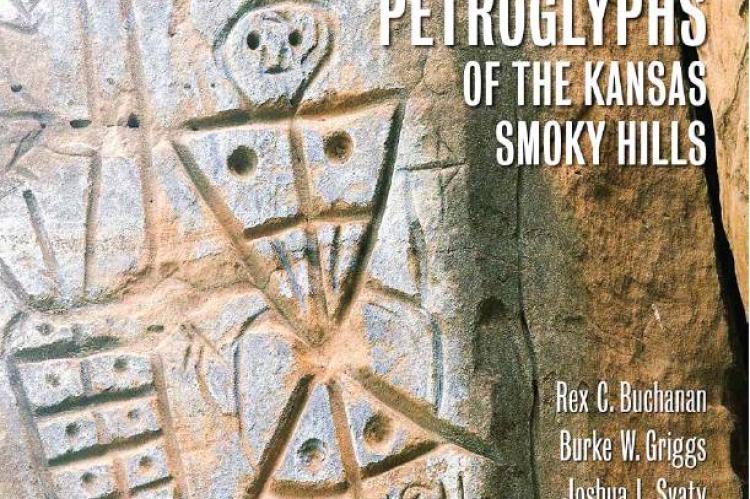
Even as a boy, Joshua Svaty sensed the carvings found at sites throughout Ellsworth County were important to the region’s history. Now, as an adult, Svaty is part of an effort to save the petroglyphs, thought to have been carved into the region’s sandstone outcroppings by its earliest inhabitants. In this case, survival comes in the form of a book,“Petroglyphs of the Kansas Smoky Hills.” Authors are Svaty, a fifth generation Ellsworth County farmer and former state legislator and Kansas secretary of agriculture who worked with landowners to arrange access to the sites; Rex Buchanan, director emeritus of the Kansas Geological Survey who wrote the bulk of the copy; and photographer Burke W. Griggs, an associate professor of law at Washburn University at Topeka. The book was published by University Press of Kansas. “We’re pleased with the results,” Svaty said this past week during an interview at the I-R office. “This is the best thing we could possibly do.” The idea for the book was planted several years ago as the result of outings taken by Svaty and Buchanan, who grew up at Little River. In April 2017, the two had dinner with Morton and Estelle Sosland of Kansas City. Morton, editor and publisher of a trade publication,“Milling & Baking News” and an art patron, died earlier this year.
As a result of that meeting, the Soslands agreed to finance the book. Their support included enough money to produce the book and its many museumquality color photos in a larger format than originally planned. The book is dedicated to Fred and Virginia Merrill, parents of the Midland Railroad Hotel’s Melinda Merrill and friends of the Soslands.
The grant also held down the price of the book to $29.95. Proceeds will go to the Ellsworth County Historical Society, the Native American Rights Fund in Colorado and the Coronado Quivira Museum at Lyons.
Included are 14 sites in Russell, Ellsworth and Rice counties.
On the cover is Inscription Rock, which is found on land controlled by the U.S. Army Corps of Engineers. The other sites are on private land and Svaty and his co-authors were careful to protect their locations.
The authors also were careful with their words. They avoided the term artwork, for instance, because they did not know whether it was accurate. A trip to Oklahoma to consult with members of the Pawnee and Wichita tribes of Native Americans confirmed the carvings were consistent with their history. But the larger question remained.
“These were made for a purpose. We just don’t know what the purpose was,” Svaty said.
He said it’s difficult to date individual petroglyphs because over the years others who came after the Native Americans left their marks on the rocks.
It’s all part of what Svaty considers the “western mystery” of the Smoky Hills.
Ellsworth County, he said, was the eastern edge of what tragically would come to be known as the Indian Wars.
“We were the beginning of the frontier,” Svaty said.
For that reason and others, he considers Ellsworth County one of the more interesting places in Kansas. It’s a past worth preserving.
Svaty remembers figures from his childhood he can no longer find. Time has already erased or worn away some of the petroglyphs and the fragile sandstone that serves as their display case.
In comments on the back cover of “Petroglyphs of the Kansas Smoky Hills,” public archeologist emerita at the Kansas Historical Society Virginia Wulfkuhle wrote,“The only way to preserve rock art — a finite and fragile cultural resource — is to record it. This book is an important contribution toward that goal.”