
Wilson’s downtown champion
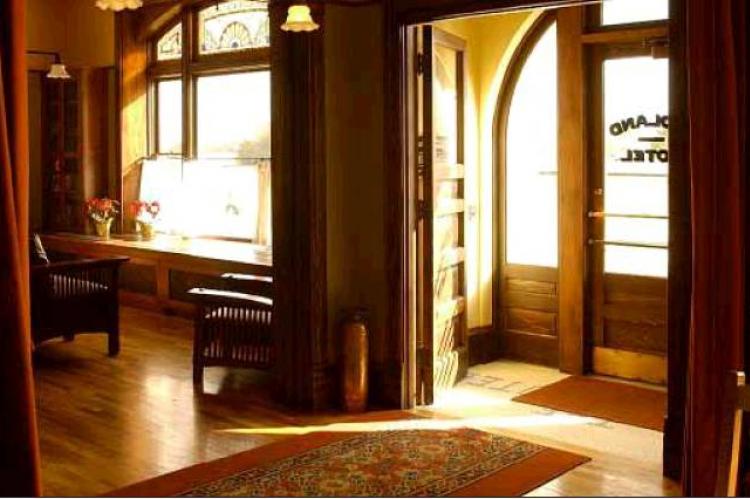
WILSON — Melinda Merrill is a preservationist.
As owner of the Midland Railroad Hotel in Wilson, Merrill breathed new life into the historic three-story limestone she bought four years ago last October.
Little by little, she’s made her mark throughout the community.
With a little ingenuity and a lot of sweat, Merrill takes older buildings and turns them into thriving businesses, which help support the local economy. It’s her way of protecting a slice of rural America, and a history that could be easily lost without local stewards like herself.
Small-town summers
As a little girl, Merrill, who lived in Kansas City, spent her summers visiting her grandparents’ wheat farm near Wilson Lake. The farm was settled years earlier by her great-greatgrandparents, who immigrated from Czechoslovakia during the early 1870s.
Some of her fondest memories, she says, were made during those Kansas summers.
“I remember attending vacation bible school at the Methodist church and picking up colored glass in alleyways, you know, those fun things you do in the summer,” she said.
“I travel quite a bit, but I love coming back here. There’s just something about a small town.”
Today, Merrill still manages the rural property, while splitting her time between Wilson and Estes Park, Colo.
While she’s a state away, she manages the Estes Park Environmental Center, a nonprofit educational organization promoting conservation through collaborations, conferences and student programs.
Tired of schlepping her things back and forth, Merrill bought a small house in Wilson around 2011. Once she settled in, she couldn’t help but notice the building across the street. The former grade school was repurposed into an assisted living facility, but the business didn’t last. Since the building was no longer being used, she decided to do something. She purchased the property in 2013 and turned it into the Czech Apartments.
It wasn’t long until a group of local residents approached Merrill about buying the hotel. Despite having no experience, Merrill decided to take a chance. Today, the hotel not only attracts overnight guests from across the country, but customers wishing to rent space for meetings and weddings.
Built in 1899, the Midland Railroad Hotel enjoyed a rich history, but eventually fell into a state of disrepair. In 1997, the Wilson Community Foundation purchased the building, embarking on a sixyear, $3.2 million renovation.
Immaculately restored, the hotel reopened in 2003. The hotel features 28 rooms, a formal dining room and a tavern known as the Sample Room, offering guests a large selection of fine whiskeys and a collection of vintage red and white wines.
During the summer, a canopy is added over a rear patio area for guests to enjoy live music and outdoor dining.
This summer, the hotel is hoping to introduce a farm-totable concept by partnering with Mosaic to raise a vegetable garden on the Midland grounds. The hotel is purchasing the vegetables, and, in turn, will feature them in certain dishes. Because the hotel often attracts visitors from out-of-state, the Midland’s menu features homecooked Midwestern favorites.
“The food we feature is catered toward this part of the country,” Merrill said.“You can have a steak or a chicken-fried steak. You can get real mashed potatoes, not the fake ones, and I think people have a real appreciation for that.”
A set of bicycles is also kept on hand for visitors. Merrill encourages guests to take a bicycle ride and see the community.
“I tell them that this is biking town that deserves to be seen,” she said.
Tourist attraction
The hotel also has a gift shop that’s located across the street. The Midland Mercantile and Art Gallery is another one of Merrill’s ideas, offering high-end gifts, jewelry and art. The shop, in a building that dates back to 1887, opened in May 2018.
“At least 60 percent of our guests are from out-of-state,” she said. “Some are traveling from coast-tocoast. They don’t want to stay in a chain hotel. They want to experience something different. Because the hotel has that historic nature, they like that.”
Wilson regularly attracts tourists who pull off Interstate 70 just to see the World’s Largest Czech Egg. But promoters like Merrill want to do whatever they can to give visitors a reason to linger a little longer.
“The key is keeping more people in town, and not just attracting people who come into town to see the egg and leave.”
Knowing they needed a game plan, Merrill and a collection of other Wilson residents began meeting more than a year ago. The discussion initially started as a part of the Strategic Doing community development project through the Dane G. Hansen Foundation. During these meetings, the group discussed ways to promote their community, and soon produced two efforts: the Wilson Czech Tourism Hub and Czech Out Wilson. Both ideas were eventually funded through grants by the Smoky Hills Charitable Foundation and the Hansen Foundation, Merrill said.
Inside the mercantile is the Wilson Czech Tourism Hub, an interactive kiosk featuring up-to-date information on various topics, including local history, tourism and events.
In keeping with the Czech egg, the community will also have seven, fourfoot Czech egg replicas placed at various locations throughout the downtown area. Merrill hopes the eggs will help draw more visitors downtown.
The group recently applied for another similar grant to fund wayfinding signs which guide visitors to certain destinations or tourist/historical sites.
To help with tourism efforts, the hub, under the guidance of the Wilson Community Foundation, will host a summer intern as part of the Hansen Foundation’s community internship initiative. The program matches communities and organizations with a specific need with upper-level college students to address that need. This summer, the intern will be producing a video, documenting longtime locals detailing Wilson’s history.
“Having an oral history like that is going to be such an amazing thing,” she said.
While some Kansas communities have all but disappeared, Merrill channels her passion into making sure that Wilson is never forgotten.
“Rural communities are near and dear to my heart,” she said. “Whatever we can do to preserve them is essential.”