
Border Man
The Way West
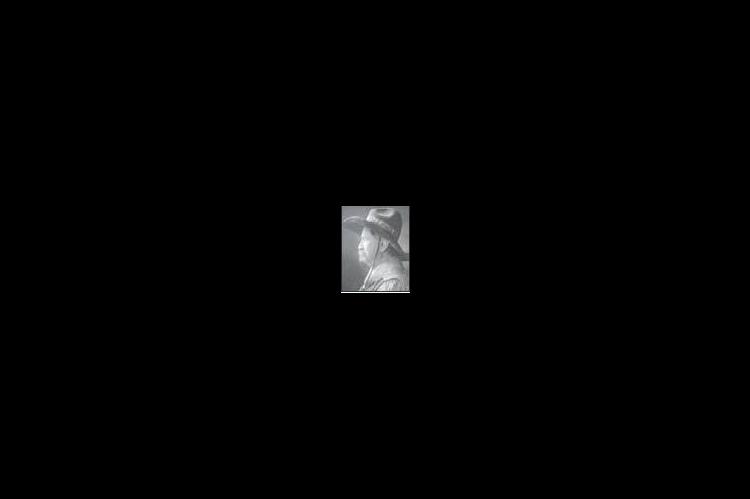
Nineteen-year-old Bedford B. Wood arrived in Kansas in 1872 to work on the surveying team of his brother, S.T. Wood, who was engaged to survey Indian Territory. At a claim east of Caldwell in Falls Township, S. T. was also building up a farm.
Soon after his arrival in southern Kansas, Bedford joined a group of cowboys headed to Texas for a return cattle drive to Kansas. Twentyfive miles south of Caldwell at Sewell’s trading ranch on Pond Creek they found that the Salt Fork of the Arkansas River was out of its banks.
After several days delay, they had to collect the horses before resuming their southward journey. Using horses kept at the ranch, Bedford along with several of his companions rode out to gather their own horses. Suddenly a puff of smoke from a hidden location in the brush was followed by the report of a rifle shot.
One of the riders, Tom Best, suddenly fell from the saddle. Rushing to his defense, Bedford and his friends found only a lifeless body. Several Osage warriors rode hard and easily escaped in heavy timber growing along a nearby creek.
Tom Best was buried at the top of a sandy knoll south of the ranch. Bedford evidently returned to Caldwell choosing not to continue further south. The episode was an abrupt introduction to the violence that prevailed on both sides of the southern Kansas border.
For the next two years Bedford helped his brother in his surveying work, keeping busy with occasional ranch work. The knowledge of the lay of the land that Bedford gained in those two years gave him an important advantage that would serve him the rest of his life.
Bedford soon learned that a man on the frontier could be rewarded handsomely for his industry. As well as surveying and ranch work, Bedford worked his own farm in Falls Township. In April of 1875 the Sumner County Press noted that Bedford Wood had 60 acres of wheat that was “hard to beat.”
In June Bedford joined an effort to organize a “flouring mill” at the “Falls of the Chikaskia River” (present-day Drury, Kan.). Bedford and a partner planted 200 acres of wheat in anticipation of the coming mill.
When he wasn’t working his fields, Bedford could be found in the cow camps of the Cherokee Outlet in Indian Territory. Texas trail drivers often delayed for days and even weeks as they passed through the Outlet, a strip of land just south of the Kansas border.
By 1874 the cattlemen were no longer just passing through. They began building temporary cow camps in the Outlet. By the late 1870s, outfits set up ranch sites, paying a nominal lease to the Cherokees.
Bedford went to work for the Snow and Rannels, an Outlet cattle company about 50 miles south of the Kansas border.
In April of 1881 C. M. Scott, publisher of the Arkansas City Traveler, “Stopped a few minutes” at Hatfield and Bedford Wood’s camp on Red Rock Creek. Unlike most cowboys of the time Bedford was not tied to only tending cattle. For a short time later that year, he served as a Caldwell deputy marshal.
In August of 1883, he was back on the cattle range as manager for the Union Cattle Company in western Kansas. However, Caldwell called him home to serve as assistant marshal under Marshal John Phillips in 1884.
When Sumner County Sheriff Cash Hollister was killed in a wild shootout, Bedford led the posse that captured his killer. A few weeks later, Nov. 15, 1884, Marshal Phillips and Deputy Bedford Wood were called to a disturbance at the dry goods store of Witzleben & Key. When Marshal Phillips stepped through the front door he commanded two brawling men to “Throw up your hands!” A few seconds later smoke filled the air. A lead ball struck one of the men, Oscar Thomas, knocking him behind a counter. Thomas was wounded but gave no indication of giving up the fight. At that moment Bedford entered a side door. Through the gun smoke he fired one quick shot and the belligerent cowboy dropped to the floor with a bullet through his head.
With the reputation of an efficient officer Bedford Wood became marshal of Kingman, Kan. A few years later, as Deputy U. S. Marshal he moved to Wichita. He was for many years the principle detective on the Wichita police force and served as Chief of Police from 1907 to 1908. According to the Wichita Daily Eagle, Bedford Wood knew more criminals and understood their habits better than anyone “then in this section.”
In his final years the aging lawman was engaged as a special agent on the Rock Island Railroad and worked as a watchman for the Eagle before passing away March 21, 1920. He was buried in Wichita’s Maple Grove Cemetery. Bedford B. Wood seldom spoke of his early days, but wouldn’t it have been something to hear him tell of his border exploits on The Way West.
“The Cowboy,” Jim Gray is author of the book Desperate Seed: Ellsworth Kansas on the Violent Frontier, Ellsworth, KS. Contact Kansas Cowboy, 220 21st Road, Geneseo, Kan. Phone: (785) 531-2058 or kansascowboy@kans.com.