
His final ruin
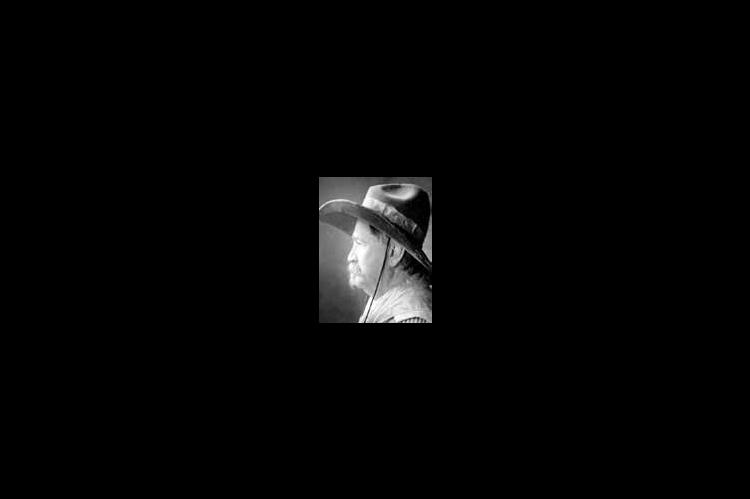
Nathaniel Ellsworth Wyatt is believed to have been born in Indiana. His year of birth is in question, having been reported from 1863 until 1870. John T. Wyatt married Rachel J. Quick of Clay County, Ind., in 1860. Rachel was 16. When the Civil War broke out, John joined the 85th Indiana Infantry.
Over the years John and Rachel produced eight children, seven boys and one girl. The family was constantly on the move, living in seven states before finally landing on Antelope Creek south of Perry, or 14 miles northeast of Guthrie Oklahoma Territory, in 1889. Rachel died the following February in 1890.
John reportedly acquired the name “Old Six-Shooter Bill” at Guthrie, where he was regularly arrested for drunk and disorderly behavior. His firstborn son, apparently a chip off the old block, was an expert gambler known as “Six-Shooter Jack.” Jack was killed over a gambling table in 1891 at Texline, Texas. Nicknames seemed to be popular with the family.
The country around Antelope Creek was known as Cowboy Flats from the days of the open range. The country was perfect cattle country. On the flats, the grass was “tall enough to tie the tops together over the back of a horse.”
The cowboy life suited Nathaniel “Zip” Wyatt. He was an expert shot with a pistol, who “delighted in throwing his long legs over a 40-pound saddle, filling up on coffin varnish and coursing wildly through the settlements, whooping and yelling and firing his Colt forty-fives at fences and trees.”
Not even marriage could change his ways.
Just after his marriage to Anna Bailey in 1891, Zip went on a “big jag” and proceeded to shoot up Mulhall, Okla. With the law on his tail, he and Anna lit out for Haviland. There, Zip and Anna’s brother, Charlie Bailey, tried harvesting wheat, but a popular horse race at the Pryor’s Grove Fourth of July Picnic offered the boys a chance to win a lot of money.
A few days before the picnic, Zip and brotherin-law Bailey stole a watch, a pair of riding gloves, a bridle and a lariat from the A. D. Roberts’ livery stable at Greensburg. Roberts reported his loss, implicating Zip Wyatt and Charlie Bailey to Kiowa County Deputy Sheriff Andrew Balfour. Balfour knew that Zip and Bailey were going to run a horse at the picnic, so he just waited to make his arrest.
When Deputy Balfour announced they were under arrest, he had no reason to expect more than a routine arrest. To Balfour’s surprise, Zip pulled his pistol. Zip’s shot echoed through the grove as Balfour, with a broken back, reacted with two shots of his own. One bullet pierced Zip’s hand and the other went through the left side of his body. With Balfour dying on the grass, the outlaws fired menacing shots into the air, daring anyone to “take them.”
Zip and Charlie Bailey disappeared into the Gyp Hills of south central Kansas. Kiowa County Sheriff James Bonsall searched tirelessly for Zip, finally catching up to him in Terre Haute, Ind. Zip was arrested while reading at a table in an early morning raid.
At Guthrie Oklahoma Territory, Zip broke jail on New Year’s Day 1892. He returned to his old cowboy haunts, sometimes known as Dick Yeager. With Ike and Belle Black, the Yeager/ Zip Wyatt gang was formed. Charlie Bailey was nowhere to be found. For the next three years, Zip’s gang terrorized the countryside with several murders attributed to Dick Yeager.
When the gang robbed a store at Fairview, Okla., on June 3, 1895, they were tracked to a cave. The ensuing gunfight lasted most of the day. Zip’s horse was killed and Black’s horse captured. The trapped men eventually escaped into the hills through a hail of bullets. There were more stores to rob and more shoot-outs. Over 200 armed men were hunting them when a bullet finally caught up with Ike Black near Cantonment Oklahoma Territory.
At Enid, Okla., Garfield County Sheriff Elsie Thralls put his own posse on Zip’s trail. Thralls had “seen the elephant” at Caldwell and Hunnewell. He had been Sumner County Undersheriff, trained by his father, Sumner County Sheriff Joe Thralls. Thralls’ family tradition left the “bad man,” Zip Wyatt, with little option but to surrender. When Sheriff Thralls caught up with him, he knew Zip was wounded from his last fight and directed his men to surround the hideout. Deputy Ad Poak and posse member Tom Smith went in to make the arrest.
At the order to “throw up your hands,” Zip “snapped to a sitting position” and swung his Winchester into play just as a bullet shattered his pelvis and another tore through his stomach, but he was still alive and able to voice his surrender.
Sightseers came from all around to see the famous Zip Wyatt in his cell. He suffered unbearably as the end drew near, and when asked if there was anyone he wanted to see, Zip replied, “Nobody to see doc; nothin’ to say.”
Blood poisoning finally did its work on Sept. 7, 1896. Nathaniel Ellsworth “Zip” Wyatt rode a hard trail to his final ruin in a lonely jail cell at Enid. Just one more tale to be told on The Way West.
“The Cowboy” Jim Gray can be reached at 220 21st Rd., Geneseo, KS 67444, (785) 531-2058 or kansascowboy@kans.com.