
Speaker discusses human trafficking
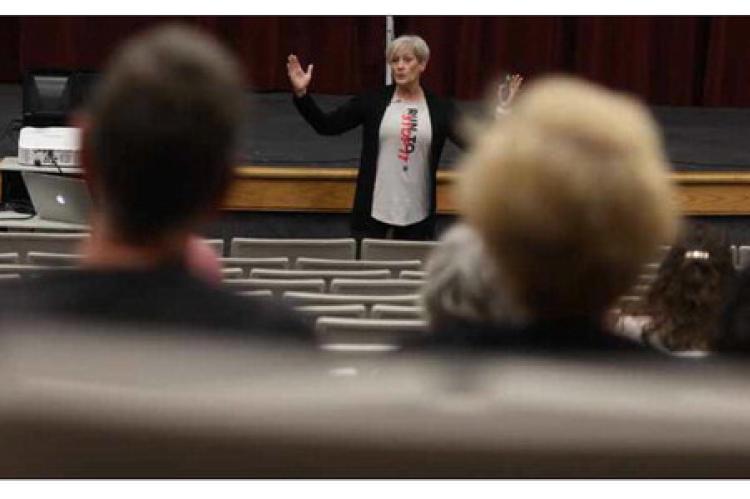
As she sat in the Performing Arts Center, the Be Alert! presentation hit close to home for April McElroy.
One of her daughters was baited by an online predator at the age of 9.
“She was baited into sending pictures to what she thought was another teenager,” she said. “Ever since then, we’ve been so guarded with our children, with any type of internet presence because of that.”
As a homeschooling family, McElroy’s children were not at the Be Alert! school presentations the following day, yet she said it was important for her to attend the Oct. 22 event.
“This brought awareness. It’s bigger — the scope (of human trafficking) is way larger,” McElroy said. “This really brought awareness to that.”
The Be Alert!: Stop Human Trafficking presentation was a collaboration between USD 327 and the Because We Care coalition. The groups brought in Stacey Lareau, who presented to adults Tuesday evening and students during the day Wednesday.
“Adults have a small window perspective of what they think sex trafficking of kids in America looks like,” she said. “Our goal tonight is to give you a big window perspective and tell you the truth about what’s happening.
“What you see tonight is not what the students will see tomorrow. It will be age appropriate for them.”
“We are not against technology and not against students. We are for you as parents,” Stop Human Trafficking founder Russ Tuttle said in a pre-recorded video.
Tuttle explained child human trafficking can take several forms.
“We think sex trafficking means a creepy vehicle and an abduction,” he said. “It happens so rarely that when it does happen, globally or in the United States, it makes all the news.
“This is not what sex trafficking looks like. It’s not the creepy vehicle. This is all about life online and seduction.”
Tuttle said adults need to know predators are seeking children and exploit the existing vulnerability of the individual.
“It doesn’t matter where you live. It doesn’t matter if you live near the right freeway or the right zip code,” Tuttle said. “You need to worry about the internet freeway.
“You would never allow a complete stranger into your home, but we sometimes do that when we don’t understand what our kids are doing online.”
He said any app that has a messaging or chat feature can open the window to unwanted communication, including The video presentation shared firstperson narratives from victims who escaped abusive situations where they were victims of human trafficking. Tuttle also shared the story of a police officer whose young girl begged her mom to play on her smartphone.
“Within less than one minute, the casing process and grooming process took immediate effect,” he said. “(The) 7-year-old thought she was talking to a boy who was 9.”
She began taking photos of her face and sharing them with the boy online.
“The boy kept pushing and saying, ‘I want to see pictures without your T-shirt,’” Tuttle said.
The girl’s father was a police officer and realized what was going on.
“If it can happen to a family that quick, no one should say, ‘Not my kid’ when a police officer and his wife are watching over their kid,” Tuttle said.
In addition to the video presentation, Lareau shared experiences with more than 100 community members who gathered at Ellsworth Jr./Sr. High School for the presentation. She shared some of the language used to discuss online predators with students. Lareau shares a story about Tuttle, who found a cockroach in his cola when he was on an international trip.
“We want them to think about their online life in the same way. If all of your extra time is spent online, it’s unhealthy to do that,” she said. “There could be a cockroach online.”
Lareau is one of the Be Alert! certified presenters. She said following a presentation in Hoisington, a 13-year-old girl talked with her about a cockroach.
“Do not be blinded by the fact that you live in a small community,” she said. “Do not be blinded by the fact that you’re a tight-knit community. Understand that if there is the internet, exploitation can happen.
“We were so proud of the 13-year-old girl who came down and told us there was a cockroach in her life, for her to trust us with that.
“It also meant we had to get law enforcement involved and the administration involved and they supported this girl so well. That night, after the presentation, that man was apprehended and held on a $1.3 million bond.”
By the time the predator went to court, Lareau said 20 students in all were identified as victims.
“One 13-year old girl changed the life of 19 other students because of her bravery to say, ‘There is a cockroach in my life,’” she said.
Tuttle said sex trafficking can take several forms.
“Child-on-child sex trafficking is increasing,” he said.
This can include students who take photos or videos of a romantic partner, peer or sibling and distribute the information online.
“The crime of sextortion, where images are being used against children, is increasing,” Tuttle said.
This can include demands to pay so a compromising photo of a youth isn’t shared online.
“If you ever encounter a kid in that situation, don’t ever pay the money,” he said. “When you, as an adult, become aware your kid has gone through something like this online, I want you to block that sender. Don’t delete. Save it. You might need to take that information to people in authority.”
Tuttle said the discussion about child sex trafficking and pornography are intertwined.
“The porn industry is trapping our students at younger and younger ages,” he said.
Often, predators will share pornography with a youth, then shame them for their feelings.
“America outweighed every other country on the planet by our porn usage,” he said. “The vast majority of pornography is viewed today by kids for the first time when they’re ages 8-11.
“I don’t want you to think this is just a male gender. Females are also stumbling into pornography at younger and younger ages.”
Data from the pornography industry shows 84 percent of porn is viewed on phones.
“We’re not angry with students and we’re not against technology,” Tuttle said. “We want to help you realize and understand the role online plays in the exploitation of our kids.”
With early exposure to pornography, he said it can have the same effects as a drug.
“Please don’t shame the student in your life. You need to understand the science of the brain,” Tuttle said. “The impact of pornography on the brain is the same as any other drug. It begins to rewire the brain. There comes a point where the brain is no longer just wanting this, it is needing this.
“Pornography is the engine driving all of these different aspects of exploitation of our kids. The only reason that kids are being treated as product is because there are sex sellers selling our kids for sex.”
Lareau shared practical pointers for adults, including:
• Don’t live in fear, but be wise.
• Don’t overreact, but don’t underreact either.
• Be the parent before you be the best friend.
• Don’t ever say, ‘Not my kid.’
• Lead by example.
• Develop a plan, be consistent.
• Have access to all electronic devices, including passwords and the ability to check them at any time.
• No technology in the bedroom. Ever.
• Check browser history.
• Look for fake accounts. “Start young, because it’s easier to teach than unteach, but it’s never too late to make changes,” she said. “You can always make a change and do something different.”
McElroy said she gleaned new information from the presentation, especially the shorthand and slang.
“I kind of thought I knew a lot of it. I wasn’t as up-to-date as I thought I was,” she said. “I wasn’t aware of how vast it was.
“Because we learned the hard way, I communicate with my kids all the time. We’re a homeschooling family, we’re a very conservative Christian family, yet it happened in our home. I’ve been extremely open with people about how it is important to almost be overdiligent.”
Tuttle said human trafficking is a global problem. He said the industry makes an estimated $150-200 billion annually.
“The three most important words you need to know are ‘exploitation of vulnerability,’” he said.
Even in a world with advanced communications and technology, Tuttle said the world can feel like a lonely place.
“Kids are (feeling), ‘No one understands me, so when it happens I’ll go into the safety and security of my screen,’” he said. “When they feel like they can’t come talk to you, they’re going online.”
More information, as well as sample technology contracts adults can use with their children, are available at thestoptraffickingproject. com. The Stop Trafficking Project also has a free app that parents, educators, healthcare, law enfocement and other professionals can download for free. The app has available resources listed.
“We’re not angry with students and we’re not against technology. We want to help you realize and understand the role online plays in the exploitation of our kids.”
Russ Tuttle
The Stop Trafficking Project Founder