
USD 327, KSHSAA add esports
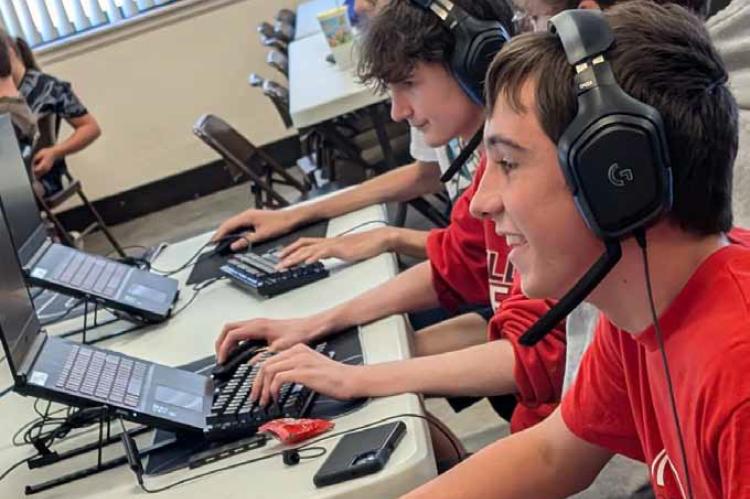
Ellsworth Jr./Sr.
High School recently approved participating in Kansas High School Athletic Association’s esports activity.
“I like that it’s something for kids who aren’t in other sports,” Board President Gina McGowan said during the Sept. 8 meeting.
It was during that meeting when the Ellsworth-Kanopolis-Geneseo USD 327 Board of Education approved the district adding esports under the KSHSAA umbrella.
EJSHS principal John Cannon said many students are involved with school activities, but not all.
“Some of (the esports) kids are not involved in anything else,” he said.
Cannon told the board between seven to 12 students participated when esports was a school club. He said this year, KSHSAA is “building the plane as we fly it.”
“It’s a good program; gets kids involved who might not get involved otherwise,” board member David Hand said during the meeting.
According to the KSHSAA website, three games will be offered in the inaugural year: Rocket League, Mario Kart 8 Deluxe and Super Smash Bros. Ultimate.
“It’s a little bit different this year since KSHAA has now officially recognized and sanctioned esports as an activity,” said EJSHS teacher Jason Maisog, who proposed the idea of an esports club to the board almost a year ago. “We have 17 players interested in playing as of our first meeting. Valorant will currently not be played.
“Sunflower League from last year has turned into Kansas Scholastic Esports, a league that is modeled after Oklahoma’s Scholastic Esports league. We are currently involved in their club season of Marvel Rivals in which about 10-12 of our players want to participate in.”
While Maisog got the club up and running, Eric Lauffer was hired during the September meeting as the team’s esports sponsor.
“The current sponsor didn’t want to be the coach,” Cannon told the board Sept. 8.
Cannon said initially KSHSAA sent a survey to schools to gauge potential interest. With an existing esports club, Cannon said the school would “maybe” be interested in joining.
“Since the end of May it’s been a moving target,” he told the board. “If you’re KSHSAA, you have to have a coach and it’s negotiated. We didn’t know where negotiations were going to be … You approved esports coach, it gave us a different tilt.”
Cannon said in June, KSHSAA decided to move forward with adding esports to its activities.
“Last month we had an hour-long Zoom meeting explaining what they wanted and their plans,” Cannon said. “A good 40 minutes was answering questions from people watching.”
Following that meeting, KSHSAA provided a more comprehensive Q&A informational packet for school districts.
Cannon said KSHSAA stipulated it will only offer the VS League, with the following games: Mario Kart, Super Smash Bros. and Rocket League.
The games are a combination of individual and team competitions, with a maximum of three players per team.
Similar to athletics, there are stipulations for the season, which will run from November-January.
“They can play separately from KSHSAA, but not during season,” Cannon said.
This is similar to athletes who are not permitted to compete in a sport outside of the school league during that sport’s season.
According to the KSHSAA website, registration is currently open via PlayVS until Nov. 30.
The regular season will run Dec. 1-Jan. 19. Preseason practice begins Nov. 17.
All competitions will be held online, and the state competition will be held in-person. State is currently scheduled for Jan. 30, but another date ( Jan. 31) can be added if needed.
Cannon said there is a slight cost to participate.
“Our costs are really low,” he said. “(We) have to pay $80 activity fee for organization. (It) goes to state trophies and plaques.”
He said each sport pays the activity fee.
Cannon said KSHSAA will not require physicals to participate at this time.
Additionally, the school will continue its “bring your own device to participate” standard. “Students will need to pay for their Nintendo accounts,” Cannon said. “Most kids already have a membership. We are not going to be paying for that.
“To play, they will need to use their Ninetndo Switch.
“Right now, they bring their personal Switch and use it during practice. We give them rights to get on our network and play the game, but that’s it.”
Before KSHSAA formally listed the activity under its activities umbrella, EJSHS students were participating — and dominating — competitions.
“The club officially began with the acceptance of the board of education the fall semester of last school year,” Maisog said.
The students did more than gather as a group to be social. Maisog said the group competed in the PlayVS League, but also in the Sunflower League, which was led by Highland Community College.
“I think it’s important to have the esports club under the gaming club umbrella because it provides another avenue for students to be engaged in now another scholastic activity,” Maisog said. “It can help allay the longstanding belief of people that video games are always just a waste of time.”
In December 2024, EJSHS’ Valorant team placed second at the 3A state championships.
Students also competed, and placed, in the Mario Kart game: first, second and fourth.
When competing against all sizes of schools in the spring, Maisog said the school’s Valorant team placed third overall, and team member Ryan Schultz placed third in Mario Kart.
“These kids are good what they do,” Maisog said. “I’ve witnessed it firsthand, because I thought I was pretty good at games, and when I first started to coach them, I was in the mindset that I’m about to teach them how to play, when in fact, they are WAY better than I am! I think it’s always good to celebrate the good things that our students are able to do.”
Cannon said joining KSHSAA’s esports program will help expand opportunities for participating students.
“Introducing esports at the high school level creates opportunities comparable to those available in traditional athletics,” he said. “Students gain valuable experience, exposure to the sport and the potential to be recruited by colleges and universities. In essence, esports athletes have access to the same pathways as athletes in other sports.”
Maisog said before KSHSAA began the activity, students encountered opportunities with the club.
“At almost every tournament that our players have been to, there have been college recruiters present and scouting players to offer scholarships to,” he said. “There were also esport teams/companies that contacted me to see if our players could play in their league for their team remotely.
“I know that area colleges such as Barton, Kansas Wesleyan, McPherson Christian, all have esports teams, as well as Wichita State, K-State and KU. Most of these colleges offer scholarships to play in their teams.”
Cannon echoed the sentiment.
“While the exact number of programs varies, a growing portion of institutions not only support esports, but also provide scholarships, some as substantial as full tuition awards,” he said. “Despite this, esports participants often encounter the stereotype that competitive gaming is not a legitimate sport.
“Yet, the qualities required of an esports athlete mirror those demanded in any other sport: dedication, determination, resilience, teamwork and self-discipline. The only distinction lies in the medium — competition takes place through video games rather than physical actions such as running, throwing, hitting or kicking a ball.”