
Bowling lanes host pinsetter school
While Rick and Abby Seiler have owned the Coach and Four Bowling Lanes for almost three dozen years, Rick was never formally trained to repair the lane’s Brunswick pinsetter machines.
“When we first started, we had a traveling pinsetter mechanic would come through once a year,” he said. “When he would go through my machines, I would try to learn as much as I could. Any time, there was a 2-hour seminar at a bowling convention on maintenance, I would go to them and try to pick up information from there.”
That all changed Sept. 25-28 when the establishment hosted a hands-on pinsetter mechanic school.
“I wanted to get more knowledge on the working of the machines; they’re a very complicated machine,” Seiler said. “I’ve always been able to kinda figure stuff out, but I wanted to get more confidence in it.
“I had been a learn-onthe- fly working on them, never had any formal training. This was one good way I would be able to take the class — host it here. If it was somewhere else, I wouldn’t be able to leave.”
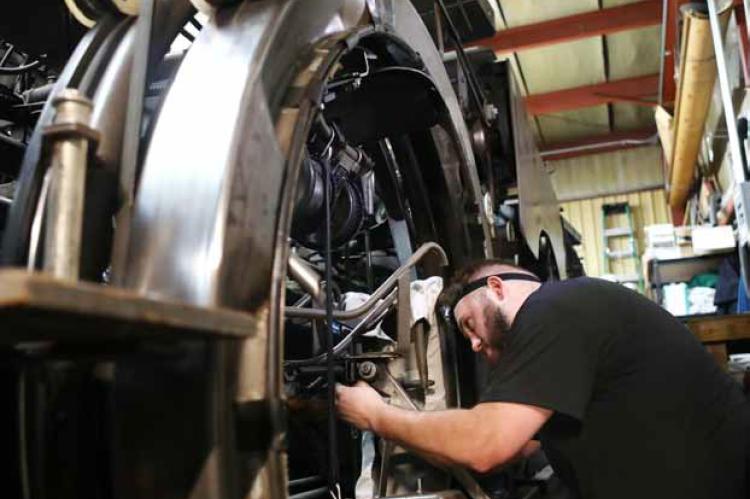
He and 10 other attendees spent time in lecture with a specialist from Classic Products Corp., and also behind the machines of the alley’s eight lanes.
They gathered from all four corners of Kansas, and even from out-ofstate as well, converging in Ellsworth to learn how to service the Brunswick A-2 pinsetting machines.
“I call them tanks,” said Stuart Treutel, a task force technical specialist with Classic Products Corp. “They run forever; those machines will run forever if you take care of them.”
Seiler said the current pinsetters in the Coach and Four were installed in 1961.
“They’re mechanical, not electronic,” he said.
“They’re heavy-duty.
They’re tanks. Now, stuff is throw-away.”
Working on these machines can be technical and could be considered a lost craft.
“Now, all the old mechanics from the 60s and 70s are retiring and there is nobody to stay with it, “ Seiler said. “The industry wasn’t set up to train new mechanics.
There are automotive schools and welding schools. If a person wanted to get into pinsetter mechanics, they have to get hired by a bowling lane.
“A good pinsetter mechanic can go anywhere in the country. It can open doors for somebody if they really wanted to do it. If you’re mechanically minded, you can learn them and go places if you want.”
Treutel said the classes are scheduled across the country, often in rural locations.
“We take some stuff apart. We adjust some things,” Treutel said. “It’s a good basic class to get you started so when you go back to your bowling center, you can look at these things. They will make the biggest impact on your bowling center.
That’s what the class is intended for.”
The Bowling Proprietors’ Association of America, Inc. contracted with Classic Products Corp. to host pinsetter classes in states such as California, Florida, Ohio, Pennsylvania and Kansas. In all, he will conduct eight four-day courses.
The year will conclude in November when he hosts a 10-day class in Las Vegas.
“That’s more deeplyinvolved, doing major gearbox overhauls, which would take a lot more time,” Seiler said. “It’s the next step up. This was an entry level to medium level class.”
While he has worked on the machines for more than three decades, it was still a learning experience.
“I learned lots of small nuggets,” Seiler said.
“More documentation type of stuff. You need to document what’s going on so you can track what’s starting to act up and what might need to be replaced.”
Sam Lengyel, Denver, was behind the machines learning how to make repairs.
“This was the closest training they had, and my manager wanted me to get some experience working on these machines,” he said.
As the class neared its completion, Seiler said Treutel completely disassembled three of his pinsetting machines.
“They were running pretty good,” he said.
“They took three machines and the mechanism which feeds the pin in, took it completely off and reassembled it.
“It made me a little nervous. They were working fine before.
There are a lot of moving parts, it only takes one to mess up. They’ve been working fine ever since.”
Class concluded on Thursday, which is also bowling league night.
“I told him he couldn’t leave Wichita until after the league had been completed the first night,” Seiler said.
Treutel said the machines are large and can seem intimidating.
“We took an assembly all the way apart. It’s an all day job,” he said.
“They really got a lot out of it.
“To me, a lot of people are afraid of what they don’t know. They’re afraid to do something because they don’t want to mess it up. Hopefully, this class teaches confidence. You get in there and know ‘I’ve done this. I am comfortable getting in there and doing it myself.’”
“...a lot of people are afraid of what they don’t know. They’re afraid to do something because they don’t want to mess it up. Hopefully, this class teaches confidence.”
Stuart Treutel
Task Force Technical Specialist, Classic Products Corp.