
Driver reminisces on racing, recreation, rescue
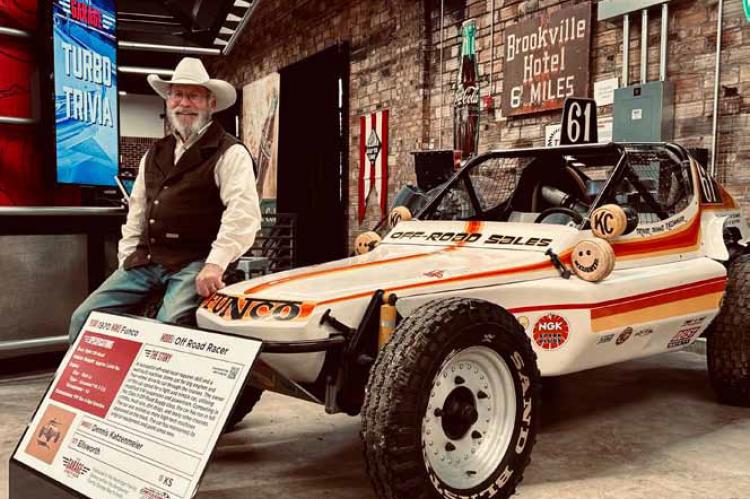
While Dennis Katzenmeier hung up his racing stripes years ago, his dune buggy was recently featured in the “Chasing the Checkered Flag” exhibit at The Garage Automotive Museum,134 S. 4th St., Salina.
“That was what was different back then. If you had any mechanic, handyman or fabrication knowledge, you could build one yourself,” Katzenmeier said.
One of the earlier designs was the EMPI Sportster. It was an angular sheet metal vehicle built on a stripped-down VW Beetle. It sold for $500.
Katzenmeier’s buggy was built from a Volkswagen.
“It was just a bunch of guys doing what they could do to get the most out of what you had to work with,” he said.
Katzenmeier, 75, Ellsworth, is a jack-ofall-trades. Having grown up on a farm, he has plenty of farming and ranching experience. He studied architecture and engineering, graduating from Pittsburg State University.
He worked in research and development for Wyatt Manufacturing for a number of years, which played a big role in his racing. At one point, he asked the company if they would mind him building a car in their shop during his offtime. To his surprise, no one had a problem with it. That is how his 1970 Funco was born.
“If it wouldn’t have been for Wyatt Manufacturing, I’d have never pursued that venture,” Katzenmeier said. “It went on for years and years and years; that wouldn’t happen in a company today.”
Dune buggies have been around since the 1950s, with a surge in the ’60s according to Dune Buggy Archives.
Beachgoers stripped cars down to the frames and supplemented off-road driving tires for a little added traction.
Dune buggies are bare-bones vehicles that traverse terrain ordinary vehicles can’t.
While many have an idea of what dune buggies look like, they can actually be any kind of vehicle. They often have large frames with engines in the rear.
“At the time, a show was on TV about racing dune buggies on the beach,” Katzenmeier said. “It had pretty girls and guys with tans and they raced these buggies on the beach in California.”
This became inspiration for Katzenmeier.
At the time, people made their own with what was at their disposal, and Volkswagen Beetles fit the needs of many people building their own buggies.
Katzenmeier started out just like that.
“Years went on and I was building sand buggies,” he said. “We had to do everything by hand. We modified Volkswagen parts; you had to make sure you had the horsepower and the wheel travel.”
While off-roading can be fun, these vehicles aren’t just for recreation, and Katzenmeier knew that. A more practical use exists in that of search and rescue. This was the idea behind the Tri-R Off-Road Association (rescue, recreation and racing).
Katzenmeier, along with Mike Lasik and Tom Pestinger, formed the organization in 1975 in Salina. These three off-road enthusiasts wanted their passion to not only be available to the community, but contribute in other ways. In their 10 years of operation, they gained about 30 members who hosted offroad races, hill climbs, BMX bicycle races, play days, trail rides and more.
However, the other side of what they did was provide support for emergency preparedness in Saline County.
They provided assistance during disasters by operating their vehicles in terrain that couldn’t otherwise be covered, Katzenmeier said.
During one particular blizzard, the club was called upon to transport medical professionals to-and-from medical facilities. They also found a Boy Scout troop that had gotten stuck at a campsite during the blizzard.
“There was about 12-14 inches of snow and we went out and picked up doctors and nurses to bring them in to the hospitals for three or four days,” Katzenmeier said.
“People just flat couldn’t get in or out.
We had about 20 vehicles at the time. It was neat we got to do some community involvement with the organization.”
The Katzenmeier family made off-roading a family affair. His children cheered him on at the races and his wife, Clovia, did a little racing of her own.
They say all good things must come to an end, and for Katzenmeier, he ended his racing career in St.
Francis, Kan. He’d been warned about a car he’d be up against that was a monster, and that turned out to be true.
Surprisingly, it wasn’t a better engine, more horsepower or even a better car that beat him — it came down to suspension.
The suspension on his competition’s vehicle was much higher than his, and it proved to be an element of his competitor’s success.
When Katzenmeier asked him about it, he learned it cost about $1,000 per corner of the car, and that was just not in his budget.
“Back when I was racing, I had to have the latest and the greatest, but I did it myself,” Katzenmeier said. “It was difficult, tough and hard to stay competitive. What I had to do was form a small company and order racing parts for people and sell merchandise; that’s what paid the bills and that is why I had to stop. That kind of money was just too much.”
He took his Funco and put it in storage.
Life moved on and his children got involved in other things while the car sat collecting dust.
“It (is) just exactly like it was when I quit racing,” Katzenmeier said. “Those tires can’t even be bought anymore. It’s a car that is just frozen in time.”
The buggy was featured in the Museum’s exhibit, which closed at the end of December.
But now the car has been brought back and dusted off, its future looks a bit brighter. It is going to receive a tuneup and maybe be entered in some car shows. Katzenmeier is bringing it back to life and reminiscing on his old racing days.
“It’s an era gone by,” Katzenmeier said.
“Racing was wonderful — the camaraderie, the people were just great.
It was challenging, fun and competitive. The thrill of racing is always a blast, and putting anything together and being successful is good.”
“It’s an era gone by. Racing was wonderful — the camaraderie, the people were just great. It was challenging, fun and competitive. The thrill of racing is always a blast, and putting anything together and being successful is good.”
Dennis Katzenmeier former dune buggy racer