
Home Sweet Home
WILSON — When Mike Peschka looks into his crystal ball to predict the condition of his community in a decade or more, he sees a vital school district with more students than today, new businesses inside Wilson’s historic buildings and enough affordable housing to satisfy demand.
Since Peschka became mayor in January, the latter two issues have been on the council table at almost every meeting.
“The city needs to be a leader on a lot of these fronts to move forward,” he said.
David Criswell, a former mayor who now serves on the council, said Wilson’s story is similar to those in hundreds of small towns across rural Kansas.
“Our community would grow if we had better housing resources. Housing is the bottleneck for us,” he said.
It’s an issue complicated by the passage of time and resources.
Criswell estimates 10 to 15 percent of the homes in Wilson are vacant, many of them under the out-of-town control of the grandchildren of the original owners. Over the years the houses deteriorate, making some of them fixable and others ready for demolition. Or a property might have junk vehicles in the front yard.
“We’re trying to address some of the blight,” said Peschka, who with the council has supported a more aggressive approach to community improvements.
In 2012 and 2013, the city received two rounds of state grants that went toward the rehabilitation of 25 houses and the demolition of another halfdozen. Officials have applied for a third grant and should hear in January whether they are successful.
Another project fell short. Melinda Merrill, owner of Wilson’s landmark Midland Railroad Hotel, offered to fund a third of the $400,000 cost of two units of moderate-income housing. The Kansas Housing Resource Corporation — the funding source for a dozen single-family rental homes in Ellsworth and two at Kanopolis — also was on board. A third potential investor decided not to participate, effectively killing the project.
Merrill considers the rejection a lost opportunity.
Her goal was to include shared work space as part of the project so employees could bring their jobs to Wilson and work remotely.
“People want to move to these rural towns,” she said.
That desire had only become stronger with the current coronavirus pandemic, she added,
Peschka said rental properties also are in demand. Hardly a week goes by that he doesn’t receive a telephone call from someone looking for a place to live.
Vacant buildings — many of them rich in history — are available in Wilson’s downtown business district, but, like a number of homes in town, they need care to become functional again.
No one knows that better than Criswell, who owns several of the town’s older buildings, including the former Olds Motor Building across from Wilson City Hall. His name also is on the title to the cluster of grain elevators that form the town’s skyline and often attracts photographers and other artists to town. Criswell carries out about two hopper cars of debris a month from the site as he goes about the time-consuming task of cleaning up the old elevator site.
“We have a lot of historic resources like that. It’s a matter of repurposing them,” Criswell said.
Money is always a consideration.
Wilson’s historic opera house has stood as a ruin since it was gutted by fire in 2009. A group was organized to save it, but members have never found the money to reach their goal.
“Their original purpose no longer exists. It’s very challenging,” Criswell said of the centu-ry-old structures that define downtown Wilson.
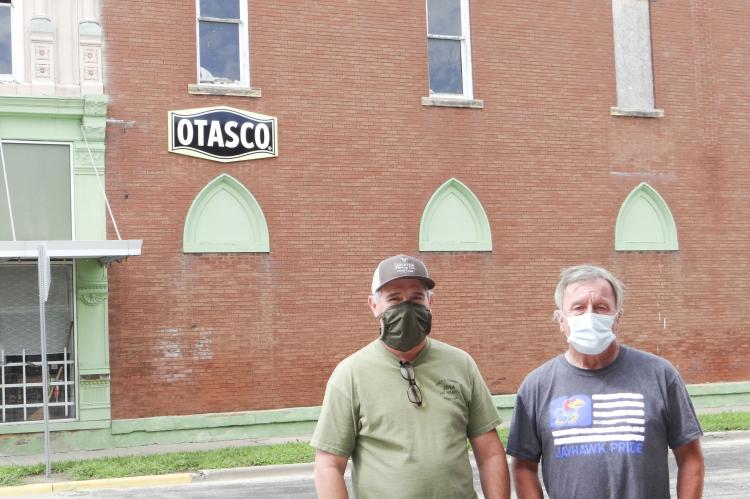
Not far from Criswell’s grain elevators is the former Otasco building, which has served Wilson for much of its history. The multi-story building stands in the middle of Wilson’s Historic District 1, which runs from south of Wilson Foods on 26th Street to the former grade school, now the Czech Apartments.
The back of the building, former home of a hardware store — among other businesses — has a large hole in the brick wall and the roof is in desperate need of repair. The Wilson City Council recently offered the out-of-town owner, who reportedly purchased the building off the internet, $12,840 to buy the property and rent a storage shed to house the contents. The owner has until Sept. 8 to act on the offer.
“Our intent is to secure the building so it doesn’t deteriorate any further,” Peschka said.
The mayor said Wilson has a lot going for it. Merrill, who helped organize a group to market the town as a tourist destination, agrees.
Two miles north of the city is Wilson Lake, perhaps the most beautiful man-made lake in Kansas. In between is Kansas Originals, a retail outlet for numerous Kansas artists and crafters, and the World’s Largest Handpainted Czech Egg. Wilson also is home to the Midland, a limestone landmark that has been restored to its former glory and serves as a center of community activity.
The city recently approved a transit guest tax, with proceeds going to tourism efforts.
Then there are the old buildings themselves. Peschka said there is interest in using them for businesses — if they can be rehabilitated.
“Wilson has tremendous potential. I think it depends on what we do today,” Criswell said.
Ellsworth seeks housing, too
Ellsworth also has received two grants from the state for housing rehabilitation and demolition.
The first, in 2014, targeted 12 houses for rehabilitation and four for demolition. The second, in 2018, involved eight houses for rehab and six for demolition, according to information from the Beloit-based North Central Regional Planning Commission. The organization writes the applications and then is paid by the cities to administer the grants.
At present, HRM Services, based in Washington, Mo., is in the process of building a dozen single family homes in south Ellsworth. Another two of the 1,207-square-foot rentals are planned for Kanopolis.
“These houses will be rental homes for 15 years as part of a home ownership program funded by the Kansas Housing Resource Corporation,” HRM Services said in a letter to residents in Ellsworth’s Canran Addition, where the homes are being built.
Renters will be given the first right to purchase the homes after 15 years.
The planning commission’s Carol Torkelson said housing is an issue across rural Kansas.
“You may have the jobs, but if you don’t have the housing, they aren’t going to come,” she said.