
Nelson continues family’s clogging legacy
For Casie Nelson, the Elizabeth A.
Hopp Fine Arts Center, 110 N. Washington St., isn’t just a building. It is a legacy.
Nelson is Elizabeth A. Hopp’s daughter, the namesake of the arts center. The name is befitting, as the center would not have existed without Hopp’s efforts. She, along with Gae Ronsee obtained the grant that allowed what was the Strand Theater at the time, to be renovated and eventually opened in 1989, which was just the beginning for Nelson. Prior to the opening, Nelson traveled to Geneseo for her dance lessons.
“I was 6 years old when I started taking dance lessons at the fine arts center,” she said.
Decades later, the center offers a number of classes for its students. From ballet to jazz to hip-hop, the studio offers a little something for everyone and Nelson is a big part of the diverse offerings. Decades after that first step onto the dance floor, the student has become the teacher. Nelson adds a little folksy flavor to fine art as the clogging instructor. It was Nelson’s mother who passed on that legacy to her as well. It’s a good thing, too. Many students owe their clogging abilities to Nelson’s instruction.
“I loved clogging,” Michelle Loder said. “I started off taking more classes than that, but I ended up getting out of ballet and jazz and just stuck with clogging.”
Loder, 22, along with her twin Madison Loder, continued their clogging lessons with Nelson right up until they graduated from high school.
Clogging involves using steps to create rhythm and sound with distinct, heavy shoes. The sounds intended to be made are linked to the dance’s history. With roots going all the way back to the 1400s, it is more commonly associated with 19th century England, according to Encyclopedia Britannica.
The clog shoe was considered cheap and comfortable footwear for industrial workers, especially for those in the cotton industry. The sound is said to be an imitation of the sounds made in the mills.
Initially the dance was developed to pass the time and alleviate boredom. It morphed into a favored pastime and source of entertainment with distinct styles for specific regions. At one point, it even became an illegal style of fighting called “purring” in which men would settle disagreements by donning the heavy soled shoes and kick one another, while wearing nothing but the shoes.
Clogging in today’s day and age is less violent. Still a fun pastime, it is often performed with music, allowing the choreography to enhance the songs.
“I loved the songs Casie let us clog to,” Madison Loder said. “It was always great to learn the dances with music we listened to on the radio. She always made it so fun.”
Nelson has a lot of experience under her belt — or shoes; both in dancing and teaching. She’s been doing it for some time.
“I have been clogging for over 30 years and have been teaching for 20 years with the last 15 years in Marquette,” she said.
Nelson’s mother heard about a clogging group in Salina and they both began taking lessons when Nelson was quite young. After a while, Hopp began teaching classes at the Fine Arts Center. During her senior year of high school, Nelson began teaching. She went on to college at Kansas State University, where she continued to teach clogging in Manhattan. In 2007 she returned to Marquette and took over as director of the center and has been teaching ever since.
Like Madison Loder said, she has a habit of making it fun and involving her students in the choreography development.
“I have many different methods,” she
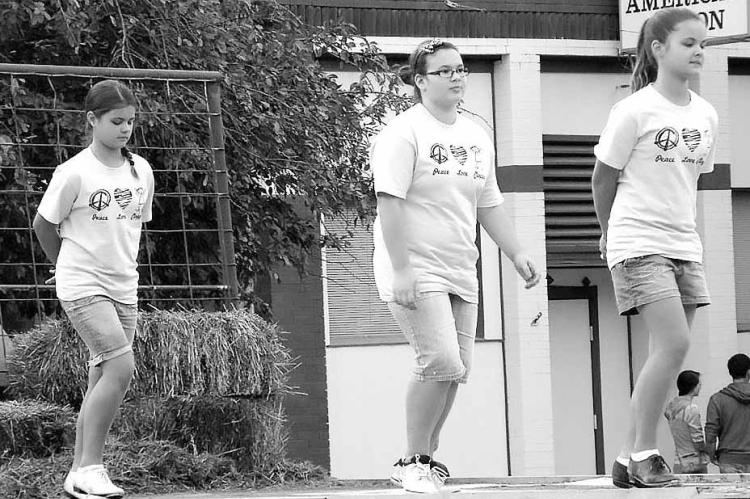
Madison Loder, Elizabeth Park and Michelle Loder clog in downtown Marquette during the Fall Festival in 2012.
explained. “Sometimes I ask the kids for their favorite song and then develop the choreography.”
Once a song is chosen, she breaks the song down into sections and choreographs each section before putting it altogether. It is a time consuming process, even for the veteran dancer.
While she has a lot of experience, Nelson doesn’t pretend she knows it all. She is still a student at times. Every year she attends a clogging workshop in Independence, Mo. At the conference, attendees learn on average 10 dances in a day. Sometimes she teaches students those dances or she might get lucky and find cue sheets for songs online she can use. In any case, Nelson matches the effort of her students.
“We loved having her teach us,” Michelle Loder said. “But it was also fun just dancing with her. She is so good at it and so knowledgeable.”
This year, Nelson will be joined by Jenna Shanks. Shanks is a Bethany College student who will be teaching ballet, tap, jazz and hip-hop on Tuesday evenings. Students in those classes must be at least 3 years old. Each class is 30 minutes and costs $30 per month. For clogging, students must be at least four years old. Nelson has three kids’ classes and one adult class.
For more information, call (785) 546-2393 or visit the Marquette Fine Arts Center Facebook page. Messages can be sent to the center on Facebook as well.
“I have so many great memories,” Madison Loder said. “I think anyone could find a class they love there.”