
Popular caboose finally gets protection from the elements
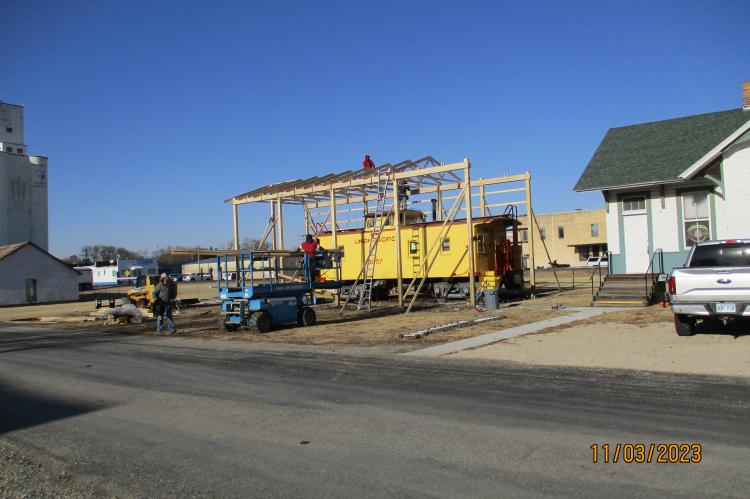
Ellsworth County Historical Society’s popular train caboose has been covered by a protective structure according to ECHS President Cynthia Edgerle. Thanks to grants from the Dane G. Hansen Foundation, the City of Ellsworth’s Tourism Committee and ECHS’s maintenance fund, Edgerle said there is now a large structure that will protect the caboose from the deteriorating effects of weather.
“We are certainly pleased to have the caboose covered,” Edgerle said. “It will save many hours of maintenance. There’s still lots to do under the pavilion, but the basic structure is finally there.”
In 1965, Ellsworth Mayor Bill Preisker requested a train car from the Union Pacific Railroad to commemorate Ellsworth’s “end of the line” history. It arrived in 1966, and was placed on the museum grounds between the Hodgden House on the east and the Morton Building on the west. The caboose was used for storage until 2008, when then-curator Georgia Smith researched the caboose’s origins and interior design. That year began the caboose’s restoration.
As one of only 23 all-wood cabooses existing in the United States, the society’s intent in 2008 was to put a cover over it. Since every part above the wheels, with the exception of the windows, is wood, the weather makes maintenance on the caboose a frequent necessity. Wood window frames rot and paint peels and fades because of the constant sun, wind and moisture. This has been noted more and more since the caboose was moved by Maico Industries Inc. to its current location in June 2016.
Prior to that, the caboose had been somewhat sheltered by the many walnut trees on ECHS’s property. Expansion of the museum’s Morton Building required the move.
A caboose was originally called the conductor’s car since it was home and office to the conductor, who had always been the main commander of any train. Originally, every conductor had his own caboose, and it always followed him, being switched from train-to-train as his destination was assigned. Eventually, the car became home to all trainmen — brakemen, engineers, signalmen and firemen.
A caboose was also the location for food preparation for the crew and the office of the conductor, who dealt with every aspect of the train’s movements and cargo. A visit to the local caboose reveals four bunks, a cold storage area, a coal bin, the conductor’s desk, a cook stove (that also served as a heat source) a storage area, a commode and a signal area with windows that could be observed from the front and back of the train.
Until the 1970s, children anxiously awaited the end of a train since a crew member was generally there to wave at them. After the late 70s or early 80s, cabooses disappeared from nearly all trains due to technological advances in steam locomotion. No firemen were needed to shovel coal, radios allowed for signaling which eliminated the jobs of signalmen and brakemen and eventually, computers controlled track switches and detected hot spots. Communication between the front and rear of the train was no longer feasible with hand or lantern signals since those could only be observed over 20 to 30 cars because use of additional engines allowed for much longer trains.
While people may miss seeing the caboose next to the Terra Cotta Depot as they travel by, preservation of this rare exhibit for the future is a priority.
“The caboose is a very popular exhibit, especially for children, but adults who see the inside of the caboose for the first time are amazed,” Edgerle said. “Most fondly remember a crewman waving at them as children, but had no idea that it served as living quarters for trainmen.”
The caboose can be toured during museum hours, Tuesday-Saturday from 10 a.m. to 4 p.m., except for national holidays.