
Prairie Gliders
Falcons find a home in Ellsworth
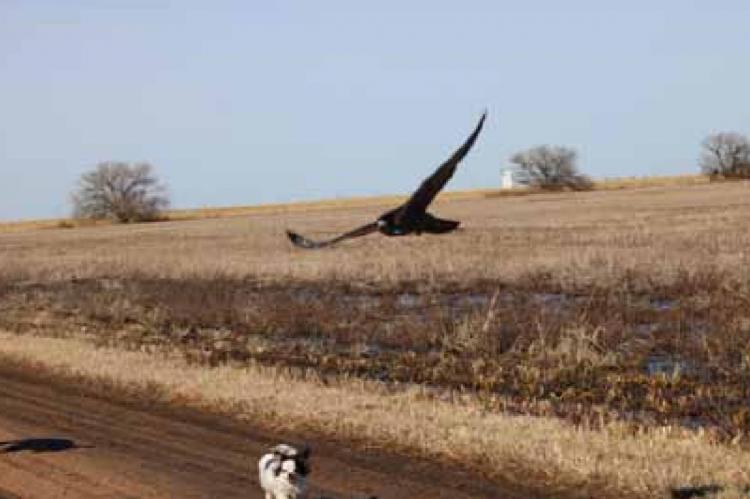
New Ellsworth resident Don McKnight brought something special with him in August when he moved from Colorado.
McKnight is a master falconer who shares his home with six falcons.
The beauty and grace of the birds were apparent on a training run during a recent Saturday morning in February. Against a blue sky, McKnight trained two birds separately with a lure, a length of rope with bait (quail) on the end. He twirled it and called the falcons to him, after which the birds dine on the bait.
McKnight, who has done this since 1964, spent 11 years in California, where he was raised on a 300-acre horse ranch, before moving to Keenesburg, Colo. He left because of increased anti-hunting sentiment, eventually landing in Ellsworth because of its abundance of wild game and conservative values.
McKnight trains his birds to take game. He does not feed them what is harvested, due to potential lead shot in the game that would poison the falcon. Harvested game goes on the table.
McKnight prefers birds raised in captivity, be they hybrid or purebred. The crossed birds exhibit stronger qualities of both species as opposed to captured wild birds. Falcons such as the Gyrfalcon come from a more Arctic immune system, and when crossed with a Saker from Mongolia, the hybrid’s immune system is much stronger for a more moderate environment.
McKnight takes his falcons to the field every week to train and feed. The younger three birds, all less than a year old, go one day, followed the next day by the older birds that range in age from 4 to 8 years. The following day, the birds remain at home, then the cycle is repeated.
McKnight uses pigeons to train young birds. Falcons flying at 2,000 feet can see a pigeon’s wing flash five miles away, McKnight said. He wants his birds to take the prey in the air.
The first level is to seal the pigeons eyes with tape.
This makes the pigeon fly straight up, teaching the falcon to fly above the prey, then descending at a speed of up to 200 miles an hour to strike.
The second level is to put an “air cone” on the pigeon. This could be a small Styrofoam cup, with a small hole in the base to place over the pigeon’s head. The air entering the cup as the bird flies prevents the pigeon from climbing. Instead the prey flies horizontally, zigging and zagging. This teaches the falcon to chase the prey after diving.
The next level is to release the pigeon on its own, allowing the falcon to hunt naturally. McKnight has raised his own pigeons, but had to give them away when he moved to Ellsworth. His plan is to capture more pigeons.
Each falcon is weighed before leaving for the field. This gives the handler an idea of how close the bird is to the optimum hunting weight. Too little or too much weight makes the bird lethargic, thus affecting its performance.
To keep track of the falcons in the field, the handler attaches telemetry devices to the birds. McKnight uses two devices per bird — a GPS tracker around the neck and a beeper around one leg to return the bird to him.
The taking of game birds in Kansas by a raptor follows the state upland game bird hunting season, starting in November and ending Jan. 31. The falconer must have their falconry license, which serves as a Kansas hunting license, and any other requirements, such as a state and federal duck stamp for the harvest of migratory waterfowl. To hunt pheasant, quail and
To hunt pheasant, quail and other upland game birds, McKnight also uses hunting dogs. He releases the trained falcon, which climbs to altitude. When the dogs point and flush a bird, then the falcon attacks. Following the falcon, the dogs collect the bird.
McKnight flies his birds until the end of March. Then the falcons will start to molt their feathers in the middle of April, producing new ones during the summer. The birds will be contained in their coops during this time, due to mosquitoes. One bite from an infected mosquito can kill a falcon in a matter of days or weeks, depending on the virus.
“Falconers are born, not made,” McKnight said. “It’s in your blood from the time you can think about it.”
McKnight is a longtime member of the North American Falconers Association. He invented the current field trail for the association by combining the aerial trial for falcons with the hunting dog trial criteria. He was founding member of the High Plains Falconers Club in Colorado and a current member of the Kansas Hawking Club.
There are three levels of falconer — apprentice, general and master. Each level has its own criteria from the Kansas Department of Wildlife and Parks.
Being a beginner, an apprentice falconer must be mentored by a general or master falconer. They may be a young as 12 years old and own only one bird.
After practicing for two years, the general falconer can have as many as three raptors and be at least 16 years old.
A master falcon can own any number of captive-bred birds, after serving for five years at the general level. These can be trained to hunt and pursue wild game.
Other requirements also apply to each falconer level.
From September through March, McKnight enjoys speaking to groups, schools and organizations, showing his passion for the sport. He can be reached at (720) 383-0571.