
The Price of Liberty
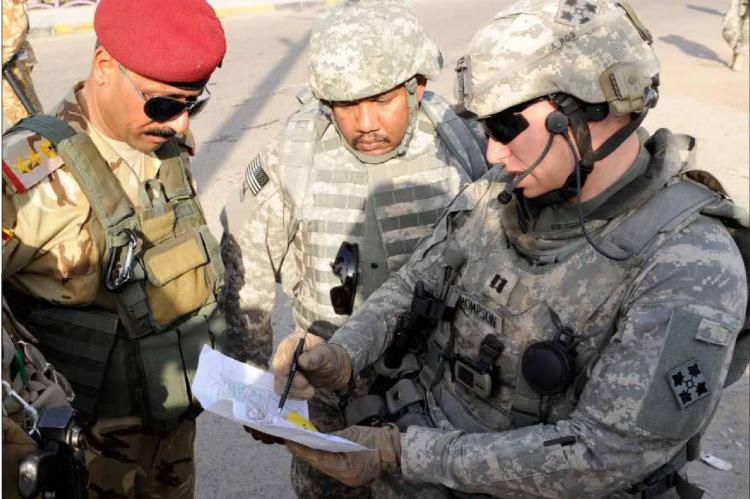
Next Monday, Memorial Day, is the date set aside to remember those who have made the ultimate sacrifice in defense of their nation’s freedom. Although U.S. Army Major Kris
Although U.S. Army Major Kris Thompson will remember many fallen comrades that day, one in particular — Captain David VanCamp — stands out.
“Dave and I came up as lieutenants together,” Thompson said. “We were in the same year group. He and I deployed together to Iraq in 2005. He was gravely wounded there by a suicide bomber.”
Thompson said most people would have accepted medical retirement, but not Capt. VanCamp.
“All he ever wanted to be was a soldier,” Thompson said. “Dave chose to undergo years of painful rehabilitation so that he could lead cavalry troopers again. He got his wish, returning to Iraq in 2010 as the Commander of G. Troop, Second Squadron, Third Armored Cavalry Regiment. He was killed in combat on June 29, 2011.”
Lest We Forget
Thompson, a 1995 graduate of Ellsworth High School, is the son of Lew and Cindy McAtee of Ellsworth and Jim Thompson.
Kris Thompson, who retired from the
Army in April after 25 years of service, realizes this Memorial Day will be different due to restrictions forced by the COVID-19 pandemic.
“Usually, Memorial Day is a good opportunity for a long weekend and backyard barbecues,” he said. “There is nothing wrong with that. Most of the people I knew who died in combat would have preferred to be memorialized with beer and burgers rather than some somber formal ceremony. Since many of us can’t gather this year, I’d recommend taking a couple of minutes to learn something about a service member who gave the last full measure to this country. All of Ellsworth County’s honored dead are listed at the courthouse memorial. A virtual version of the memorial is located at https://www.hmdb.org/m. asp?m=54093.
Google one or two of those names and find some information about your hometown heroes.”
Dedication to service
Thompson enlisted in the U.S. Army after high school and chose as his military occupational specialty to be a tank crewman.
Thompson said he enlisted for a variety of reasons.
“I didn’t know what I wanted to do with myself after high school. I was honest with myself enough to know that I was not disciplined enough to be a college student. Most of the men I respected had served in the military, and it seemed natural to follow in their footsteps.”
One of those men was undoubtably Tommy Zouzas, Thompson’s neighbor, who served as a paratrooper in World War II.
“The Boy Scouts and the church had instilled an ethic of service in me as well,” Thompson added.
Thompson said if he was going to join the military, he wanted to be in the combat arms.
“I was never very athletic in high school,” he said. “I thought tanks would be less physically challenging than infantry. That was a false assumption!”
As Thompson put it, infantrymen do cardio. Tankers lift.
Thompson graduated and earned his commission as an Army second lieutenant in 2002 from the University of Kansas in Lawrence. He majored in American history.
Once commissioned, Thompson led a Bradley Linebacker platoon during the initial invasion of Iraq in 2003, then transitioned to an armored reconnaissance squadron in 2004. From 2005-06, he served as a military advisor to the Iraqi Army.
After completing the Captain’s Career Course, Thompson returned to Baghdad, Iraq for the “Surge” in 2008.
“I commanded a tank company in Basra, Iraq, in the final days of Operation Iraqi Freedom,” he added.
For the next three years, Thompson taught military science and leadership at several colleges in northern Pennsylvania.
Thompson then attended the Command and General Staff College before volunteering for a Pentagon program called the Afghanistan/Pakistan Hands. After a year of foreign language and tactical training, he was assigned to the Resolute Support Headquarters in Kabul, Afghanistan, as an operations officer in the International Agreements Branch in 2015-16.
In 2017, Thompson returned to Washington D.C. and earned a Master’s Degree in Strategic Security Studies from the National Defense University.
In 2018 he returned to Afghanistan, as the operations advisor for the Afghan Army in Southern and Central Afghanistan.
Experiencing Combat
Thompson said combat is the worst possible human condition.
“There is no honor in it,” he said. “There is no nobility. I never met my enemy at dawn with flags flying like they do in the movies. Combat is cruelty and tragedy. It destroys the facade of mankind as a noble creature and reveals him for what he is — a highly efficient predator. Combat rewards actions which would be capital crimes under any other circumstances.”
Thompson said combat is awful, but necessary.
“Some people cannot be reasoned with,” he said.
Standing up to be counted
Thompson said during his time in the Army, he has had the privilege of watching citizens risk their lives to vote in two very different countries — Iraq and Afghanistan.
“In Iraq in 2005, al Qaeda in Iraq vowed to kill anyone who attempted to vote,” Thompson said. “The risk of car bombs was so high that the Iraqis had to build walls and roadblocks around polling sites. People had to walk for miles to cast their votes. They came in the thousands. In Afghanistan too, the Taliban and ISIS both threatened to kill anyone who dared to vote. Five days before the election we held a major security conference in Kandahar to finalize our plans for election security. When the meeting was over, a Taliban assassin in an Afghan military uniform killed the provincial police chief and the head of the Kandahar intelligent service. He also shot and wounded my boss, his interpreter, my Afghan army partner, and the city mayor before we killed him. That all took place in the space of about 10 seconds. Our plans were thrown into chaos. Every senior Afghan leader in Kandahar was either killed or wounded. There was no guarantee that we would be able to keep the polling stations secure, but the Afghans came out to vote anyway in larger numbers than anyone had expected.”
Given all this, Thompson said he doesn’t miss a chance to vote.
“Whether it’s for President or school board, I exercise that right and hold it sacred,” he said.
Deciding to retire
Thompson said he decided to retire during his last Afghanistan deployment.
“I had been considering retirement since my teaching days in Pennsylvania,” he said. “It was becoming obvious to me that the constant deployments were having a negative effect on my family and on my own mental health. After the last deployment to Afghanistan, I felt like I had accomplished everything I was ever going to accomplish in the army. It was the right time to let go.”
Thompson’s last command in the armor branch was in 2011 with Charlie Company, 1st Battalion, 68th Armor Regiment
“I volunteered for the AFPAK Hands program in 2014 because there was little use for tanks in the counter-terrorism environment after the end of Operation Iraqi freedom,” he said. “I commanded an expeditionary advisor task force in Afghanistan in 2018-19.”
Looking back
Now that he is retired, Thompson said he thinks he will miss the camaraderie and teamwork of soldiers.
“Because our lives depend on each other, there was very little petty bickering amongst combat soldiers,” he said. “The things which cause people stress in the civilian world are meaningless trivialities and combat. While I will not miss anything about fighting, I will miss the clarity of being on the team.”
Facing your fears
Thompson said facing up to and owning his fear was the biggest challenge he had as an Army officer.
“Being in charge is a lonely position,” he said. “When I was an enlisted soldier I always had my buddies and the guys on my tank crew to complain to and to go to for help. When I became an officer, I had to always act like I knew exactly what I was doing, even though I was making it all up nine times out of 10!”
Thompson said his biggest reward was the people he has met around the world.
“My great fortune has always been the people I have met in my travels,” he said. “I have made friends around the world and stood alongside true heroes. I don’t think that any other profession provides a similar opportunity.”
State of the Army
Thompson said when he first joined the Army, it was looking for a purpose.
“It was just after the 1991 Gulf War, the Soviet Union had dissolved, and we had no great competitors,” he said. “When we trained, it all seemed academic, and sort of silly. There was always some sergeant major yelling at us for meaningless things like not having our boots shiny enough, or not having the little brass brackets on our gear painted black. What does any of that have to do with combat?”
However, after Sept. 11, 2001, that all changed.
“All of those parade ground soldiers were sidelined,” Thompson said.
He said there is not another military like that of the United States anywhere else in the world.
“No other military force even comes close,” he said. “We have been seasoned by 20 years of war. We provide options to the President ranging from the subtlety of a joint exercise or carrier strike group to the overt threat of total nuclear annihilation. In the full spectrum of military conflict, we are peerless.”
Thompson said the problem is that the U.S. does defense so well, it makes people think the Department of Defense can do everything well.
“If the President gives the DoD a mission, we do the best we can with what we’ve got,” he said. “Our resources, though massive, are finite. We are simultaneously trying to fight a pandemic, terrorism, Chinese expansion, Russian cyber threats, Iranian proxy wars, narcotics smuggling, climate change, and a host of other nondefense related initiatives. We can do all of that, but the more we are tasked with, the less effective we are in each of those tasks.”
A valuable lesson learned
Thompson said his years of service in the Army have taught him to never take the privilege of liberty for granted.
“Individual freedom is valuable beyond measure,” he said.
What’s next?
Thompson said he has taken a job in the intelligence community and plans to spend a lot more time raising his children.
‘Nothing I have done as a soldier is more important to me than my family,” he said.
Any regrets?
Thompson said he doesn’t have any regrets from his service in the Army.
“I can wish that things had gone differently, but what is the point” he asked. “Carrying that baggage around doesn’t do anyone any good. There’s nothing you can do to change the past. I have learned the hard way that it’s better to just let the past go and concentrate on the here and now.”
"We can do all of that, but the more we are tasked with, the less effective we are in each of those tasks.” Major Kris Thompson