
USD 112 members get KOMA training
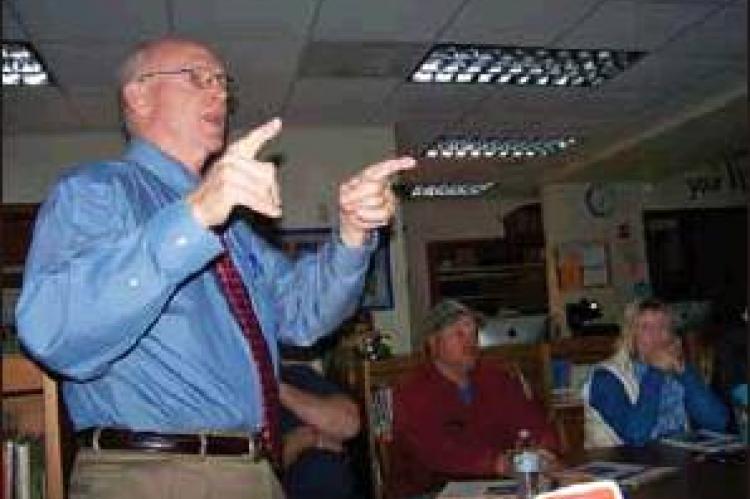
HOLYROOD — Members of the Central Plains USD 112 board of education gathered Jan. 9 at Central Plains Elementary School in Holyrood to learn more about the Kansas Open Meetings Act.
The training was required as part of a settlement with the Kansas Attorney General’s office in Topeka to resolve a violation by the board of the KOMA.
As reported in a previous edition of the Independent-Reporter, in November, the board self-reported to the attorney general’s office that it had violated KOMA by improperly discussing matters in executive session that should have been discussed in open session.
Upon investigation, the attorney general’s office determined the board violated KOMA on two occasions by improperly recessing into executive session to discuss matters unrelated to the justification cited in the board’s motion. The board’s motions to recess into executive session also failed to include the place where the open meeting would resume.
At the conclusion of the investigation, the board signed a consent order admitting that it violated KOMA and agreed to obtain training. Members also agreed to provide written confirmation that each member obtained the required training, to conduct a prompt review of any existing board policy or draft and adopt a policy that addresses board responsibilities and executive sessions and provide written confirmation of doing so, and not engage in any future violations of KOMA.
The hour and 15-minute-long training session was led by board attorney John Sherman of Ellsworth. In addition to the required USD 112 board members, newly-elected board members Chad Rogers and Josh Hurley attended the training as well, along with superintendent Greg Clark and board clerk Diane Ney. Sherman presented information from the attorney general’s website titled “A Citizen’s Guide to Open Government.” “It’s generally a pretty good guide,” Sherman said. Here is a brief overview of the session. Sherman said the Kansas Open Meetings Act is a law that guarantees anyone the right to observe governmental policy makers, such as local school board, city council and county commissioners, or most functions of the state legislature, that made the decisions affecting the lives of Kansas citizens. “It applies to public bodies in the State of Kansas,” Sherman said.“Interestingly enough, there are about 4,000 public bodies in the State of Kansas. The attorney general’s office said we’re probably number seven or eight in the country in the number of public bodies we have.” Sherman said KOMA only applies to a public body or agency. It does not include staff meetings for a public agency. And it does not apply to elected officials who are part of a public body, such as the governor. Courts and judges are also excluded from the KOMA.
Not Covered by the KOMA
Sherman noted the KOMA does not include a requirement for an agenda. “I think people get confused on this,” he said. “It does not.” Sherman said public bodies are welcome to have an agenda, but are not required to have one. “If you have an agenda and somebody wants notice, the agenda should be sent to them,” he said. The KOMA also does not require detailed minutes of all the items discussed at a meeting. “KOMA doesn’t address how you should maintain or keep your minutes, except for a specific circumstance, and that’s executive session,” Sherman added. “In executive sessions you’ve got to have motions to go into executive session and they have to be completely recorded in the minutes and have to have the proper provisions in them.”
Executive sessions
Sherman said an executive session is when the public body is permitted to discuss certain subjects in private. An executive session can only take place once a open meeting is convened. A motion to enter executive session must have three parts. First, it must have a statement describing the subjects to be discussed in executive session, without revealing confidential information. Second, the justification. Sherman said this is the statutory wording, such as to discuss non-elected personnel. Third, the time and place at which the open meeting will resume.