
Vet reaches back in time to treat hospital’s four-legged patients
There is a popular saying often used in today’s culture that states “What is old is new again.”
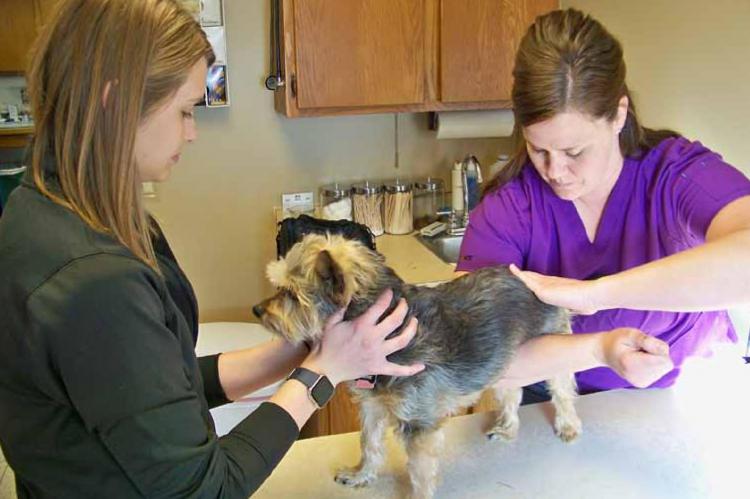
Dr. Laurel Davis of the Ellsworth Veterinary Hospital has given new life to that saying. Since October, she has offered a 125-yearold service to help animals of all sizes and types feel and live better — animal chiropractic.
“A lot of people don’t want to throw medicine at their animal,” she said.
Davis said animal chiropractic is something she has wanted to do since she graduated from veterinary school in 2012.
“We always have animals coming through that are arthritic, or are wobbly in the back end,” she said.
Ellsworth Animal Hospital also sees a lot of what Davis describes as “back” dogs — breeds like Dachshunds that have long backs.
“Their backs are so long, all of a sudden, their backs go out,” she said. “We treat those medically right now. But with chiropractic, you can actually treat the problem instead of just covering it up with medicine.”
Davis said animal chiropractic dates back to 1895, and was the forerunner of human chiropractic services.
Davis said since animals are quadrupeds (they walk on all four legs), gravity effects their spines differently than humans, which are bipeds.
“That’s why there are problem areas in the middle of their spine,” she said. “They have different issues that we do.”
Davis said the animal chiropractic techniques used today were developed in 1988 by a veterinarian, Dr. Sharon Willoughby.
Willoughby graduated from both veterinary and chiropractic school.
“There are all kinds of different techniques,” Davis said. “In July, I went to a place called Options For Animals in Wellsville, Kan., and that is the school she actually started. She figured out what angles you adjust animals at.”
The course on animal chiropractic which Davis studied lasted five weeks. She then became certified in animal chiropractic by the International Veterinary Chiropractic Association.
“I learned on dogs and horses, but I adjust my goat at home, and we’ve used it on a calf here and there,” she said. “We’ll do a lot of horses and we get a lot of dogs. It’s pretty cool. It’s rewarding.”
Davis said most people have no idea the Ellsworth Animal Hospital offers animal chiropractic.
She said an animal’s body — like a human’s — has an innate ability to heal and regulate itself.
“We try to correct it, just as in humans,” Davis said. “We go through the spine and we see where the problem is at in the spine.”
The specific technique Davis uses is called motion palpating.
Using only her hands, she motions each joint of the animal individually, putting it through the animal’s normal range of motion.
“On a horse you might use your whole body to motion through it and on a dog you might use just your thumb,” Davis said. “It depends upon the animal. Once you find the joint that has decreased motion, then you figure out is it moving this way or that way, then you figure out how to adjust it.”
Once the joint is adjusted, then the animal’s body can regulate itself again.
Davis remembers performing animal chiropractic on a yearling filly being used for a lunge class.
“She could lunge really good on the line to the left,” Davis said. “She could walk, trot, canter and move really good to the left. When she would turn to the right, though, she’d start rearing up and acting up.”
Davis said the owner of the horse thought the animal had a behavior problem. That turned out not to be the case, however. It was discovered the horse had flipped onto her back in her stall.
Davis said the horse had some withers that needed adjusted and she couldn’t turn her head to the right. After Davis adjusted the animal’s low cervical joint, it could wrap her head around with ease.
“It was cool, because we could see the results right away,” Davis said. “We took her out to the pasture and she was running circles and going crazy.”
Davis has seen the same positive results in dogs as well. One of those dogs, Lizzie, belongs to her colleague, Dr. Bryon Davis. Lizzie suffered from arthritis in the pelvic area of her spine — something common in all dogs. In addition, the first vertebrae behind her left ear was stuck.
Davis adjusted Lizzie twice. Now she is doing much better.
“He (Wilson) brings her in once a month to keep her up-to-date and to make sure the adjustment holds,” Davis said.
Davis said when it comes to adjusting animals, attitude can be an obstacle.
“The biggest thing is if the animal is going to cooperate or not,” she said. “So you have to move it through it quickly, because they lose interest or they don’t want to participate.”
Davis said veterinarians, in general, have a keen appreciation for chiropractic since their bodies take quite a beating daily on the job working with cattle and horses.
“I believe in it (chiropractic) for my health, personally,” she said. “I think it makes me feel better.”
Davis said animal chiropractic and human chiropractic differ in that she uses only her hands to adjust animals, whereas tools and manual manipulation can be used to adjust humans.
“There are all kinds of different techniques,” she said.
Davis said she is often asked how she can adjust a horse. Her answer is simple. She is not adjusting the whole animal at one time.
“A lot of cowboys with their horses they use it (chiropractic) a lot,” she said. “They’re pretty excited about it because they’ve been wanting something like that in our area.”
Davis said she hopes animal chiropractic really blossoms for the Ellsworth Animal Hospital.
She said plans are in the works to build an addition onto the hospital sometime next year to accommodate more examination rooms, etc.
“We’re excited to keep growing and serving the community with more options,” Davis said.