
Wilson rejects goat plan
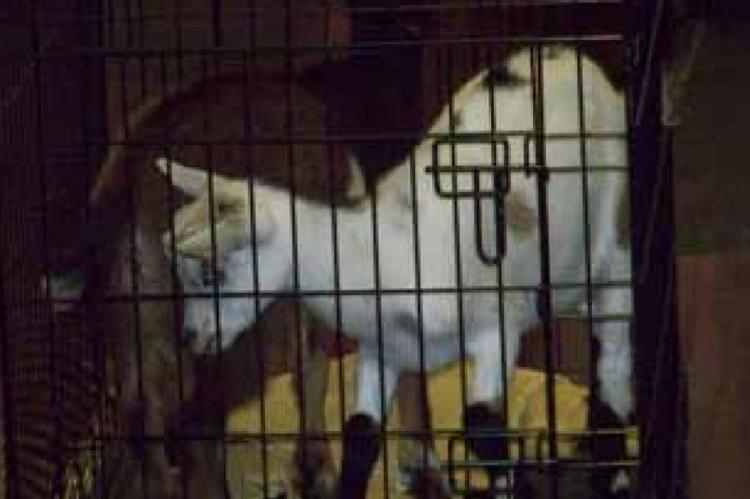
WILSON — A request by Kansas Foods owner and Wilson City Council member David Criswell for a wavier to raise more than two Nigerian dwarf goats on his property in downtown Wilson was denied July 6 at a meeting of the city body.
City ordinance limits residents to two animals and Criswell said he hoped eventually to raise as many as 100 goats on his property, which extends from the north side of the railroad tracks near the grain silos across the street south of Wilson Foods westward.
In his request Criswell noted the goats would be kept on the far western part of that property, known as the 700 block of 26th Street — not on his property directly across the street from Wilson Foods, known as the 500 block of 26th Street.
Criswell considers his new agritourism business, Petti Goats Junction, something that would bring more people into Wilson. The goats would be raised for their milk and to sell.
The final vote came after council member Chuck Crawford’s motion to allow the wavier died for lack of a second. Almost immediately afterwards, council member Dan Taylor motioned to deny the wavier request. His motion was seconded by council president Cindy Heinze, with the vote being two for and one against. (Council member Darcy Hubka-Vopat abstained.)
During open discussion before the vote, Jeff Keith said the goats would not be a good for the community because they stink, they take maintenance and they will take away from the beautification the city is trying to do to bring people into Wilson.
“We elect you guys to the city council to work in our best interests,” Keith said. “I hope you guys will take that into account because the community depends on you to do what is right for us as a people — not do right by your personal wishes — it’s about the community.”
Jeremy Hlad was concerned that no educational material has been presented to the public on Criswell’s plan for the goats.
“It’s all been heresay,” he said. Hlad said if the council were to approve the waiver request, that decision could negatively affect Wilson Foods.
“The grocery store brought in a lot of people over the Fourth of July weekend,” he said. “I am not saying the impact will be negative, but it runs that risk.”
Rick Weigel, owner of Wilson Foods, said he visited with Melinda Merrill, owner of the nearby Midland Railroad Hotel, about the goats. Weigel said both he and Merrill agreed that keeping them in downtown Wilson would not be good for either business.
“Let’s face it, I’ve never met an animal or a human where poop and urine don’t stink,” Weigel said. “And the wind comes out of the south. So I can imagine on a 100-degree day and that wind coming out of there, that we would get the smell.”
Weigel said he told Criswell he was all for him putting the goats in other places in town with the exception of Main Street.
“I think it would affect some of your main businesses,” he said.
“My concern is once you open the door, you cannot discriminate a wavier,” said Lori Taylor. “If someone comes and wants a wavier and they meet all the guidelines you can’t say to them, ‘no you can’t have them’.”
City attorney Theresa Staudinger said liability concerns would be low for the city, because the responsibility would be on the owner of the goats and the property, not the city.
She wondered that even if the council allows the wavier, would the railroad allow it as well? She also raised concerns about the goats escaping from their pen and getting injured on the nearby track.
Criswell said he hasn’t talked to the railroad about the goats.
“I’ve talked to them many times in the past and they really don’t care what you are doing with the land as long as you pay your lease,” he said.
“I would hate to think that we allowed something to occur on railroad property — even though it’s really not our business, it’s yours — that down the road had a negative impact,” Peschka said.
Criswell said he appreciated the comments.
“This will be the fifth business I’ve started,” he said. “They’ve all been successful and all four of those have helped Wilson.” Heinze said she has been on
Heinze said she has been on the council a long time and animals are a big issue every year.
“We have worked very hard on coming up with a solution to the problem,” she said. “And Dave, I have nothing against your goats. I just don’t think that’s the spot for them.”
Heinze said the key question was if it was anybody else besides a council member asking for the waiver, would the council even consider it?
“Let’s be honest with ourselves,” she said.
Criswell said he didn’t agree with Heinze’s statement.
“I just happen to be a city council member,” he said. “I also happen to be a business person and an entrepreneur.”
“I’m not against the goats as a whole. If they’re outside of town, I have no problem with that,” responded Heinze, who also pointed to the council’s past refusal to waive the ordinance for 4-H members.
“I’m just asking for some open minded consideration,” Criswell said.
Criswell said he has spent time and money trying to develop his property into something positive for the community.
“We do 99 percent of our shopping at your store,” Criswell told Weigel. “We are the last people in the world that are going to harm your store. I will absolutely not allow that to happen.”
Criswell noted none of his goats will have horns. He also promised the animals would be managed in such a way as to eliminate odor and flies.
“I feel with every fiber in my being that this will be the most successful business I’ve done,” he said. “I’m asking you to give it a chance.”
In a telephone interview with the Independent-Reporter after the meeting, Criswell said he still plans to raise goats in some form, whatever the law allows.
“There has been a lot of misinformation about the goats and the negative impact to the community,” he said.
As such, Criswell said he plans to continue to educate Wilson residents on what he is trying to do and the benefits his planned business will bring to the community.
Once again he said the goats will not be directly across the street from Wilson Foods, but much farther west.
“It’s a good place for them,” he said.
In other business:
• Property owner Dan Erdman questioned Peschka about the two vehicles deemed a nuisance by the city board of health.
Erdman said the city ordinance says that a lack of current license tags and insurance is a presumption of a nuisance.
“I had to get rid of my cars then I heard that somebody else had five cars, no tags, no insurance, and you said it was okay,” Erdman told Peschka. “Are you picking on me?”
Peschka said the night Erdman was at the council meeting, he asked Erdman numerous times to show the council they were operable and the matter would be done. He refused.
“I gave you the opportunity,” Peschka said. Peschka said the issue of tags
Peschka said the issue of tags and registration was a concern he talked to attorney Staudinger about. She plans to review the ordinance.
• Approval was given to the housing and demolition plan developed by the North Central Regional Planning Commission in Beloit to provide property owners in the area from 27th Street north to Old 40 Highway the opportunity to apply for up to $25,000 in rehabilitation or demolition to their property. The funds were provided by a $300,000 grant from the Kansas Department of Commerce.
• Approval was given to an engineering agreement with Wilson and Company as a first step in eventually building another detention pond at the city sewer pond due to changing state regulations.